
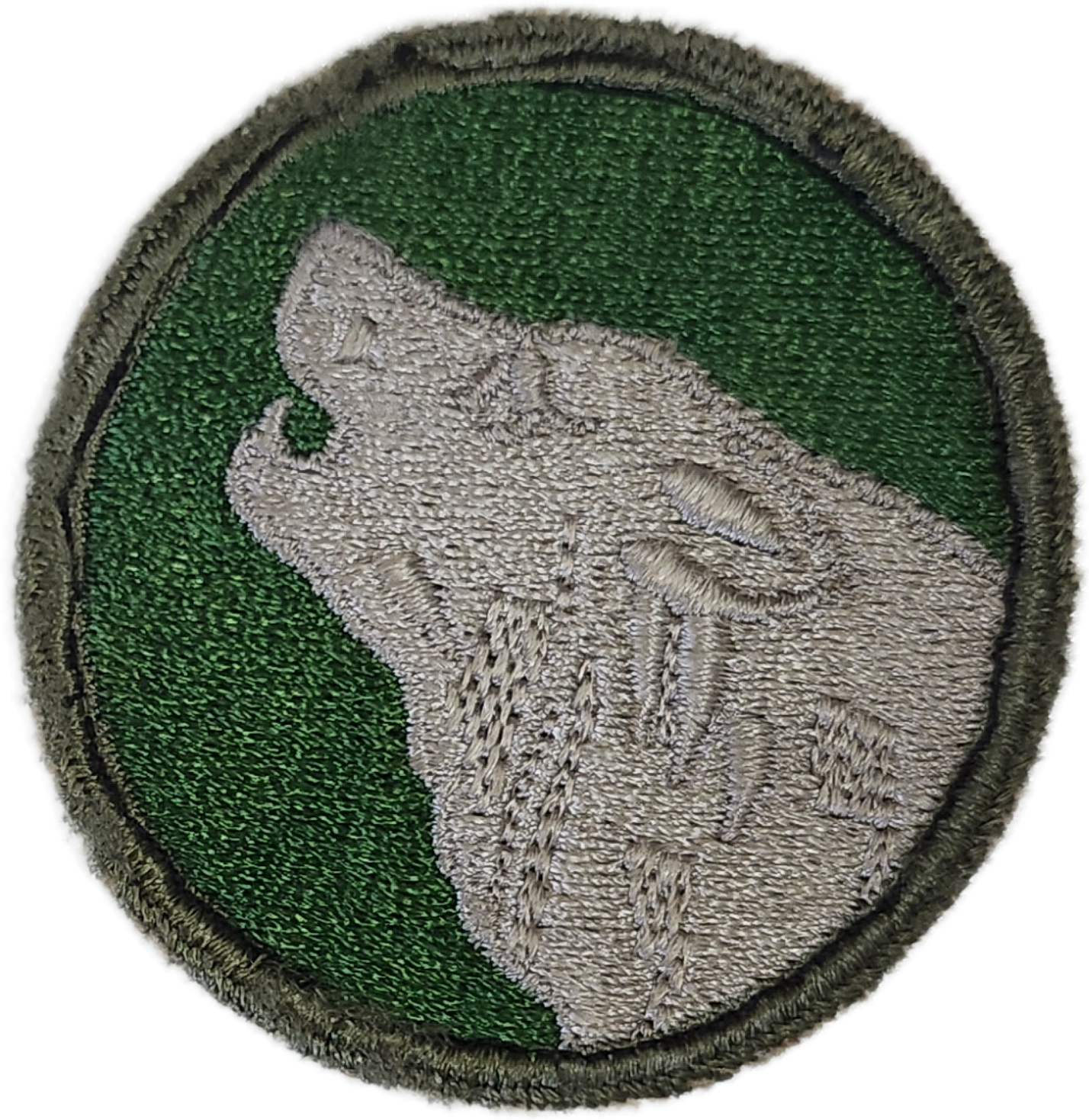
104th Infantry Division “Timberwolves”
The 104th Infantry Division, famously known as the “Timberwolves,” has one of the strongest connections between Camp Adair and the American ground war in Europe. Activated at Camp Adair, Oregon, in September 1942, the division would spend roughly two years transforming thousands of civilian soldiers into a combat-ready infantry division before fighting its way across northern Europe in 1944–45. The division ultimately spent 195 consecutive days in combat.
Activation at Camp Adair
The 104th Infantry Division was formally activated at Camp Adair on September 15, 1942. Major General Gilbert R. Cook was its first wartime commander. The division's headquarters and newly assigned soldiers began the enormous task of building a combat division essentially from the ground up.
Camp Adair was an ideal—and demanding—place to prepare an infantry division. Constructed in the Willamette Valley beginning in 1942, the camp contained more than 1,700 buildings and extensive training areas. Soldiers trained with rifles, machine guns, mortars, artillery, antitank weapons, explosives, and other equipment while maneuvering through terrain intended to provide realistic combat conditions.
For many of the Timberwolves, Oregon became their first experience of military life. Basic training began in December 1942, and thousands of men learned the fundamentals of soldiering at Camp Adair—marching, weapons handling, physical conditioning, field sanitation, communications, map reading, camouflage, and small-unit tactics.
The wet Oregon winters also provided an important lesson. The Timberwolves were learning to operate in conditions that could be physically miserable, while their officers worked to turn individual soldiers into cohesive companies, battalions, and regiments.
Training Beyond Camp Adair
Camp Adair was only the beginning.
In 1943, the division conducted large-scale maneuvers in Oregon before moving into the California-Arizona desert training area. These exercises introduced the soldiers to a dramatically different environment and tested their ability to operate as a complete division. The division subsequently moved to Camp Carson, Colorado, for additional preparation for overseas combat.
Major General Terry de la Mesa Allen assumed command in October 1943. Allen was a veteran combat commander who had previously commanded the 1st Infantry Division in North Africa and Sicily. Under Allen, the Timberwolves became increasingly focused on the realities of modern infantry warfare.
The division's component infantry regiments were the 413th, 414th, and 415th Infantry Regiments, supported by its field artillery battalions and other divisional units.
Going to Europe
In August 1944, after extensive preparation, the Timberwolves left the United States for the European Theater. They arrived in France in September. The division then moved north toward Belgium and the Netherlands, where it would enter combat as part of the Allied advance against Germany.
The transition from Camp Adair to combat was enormous.
Men who had learned to march through the Oregon rain, qualify with weapons on Camp Adair's ranges, live in barracks, eat in mess halls, and train on the Willamette Valley's fields were now moving through war-torn Europe.
First Combat — Belgium and Holland
The Timberwolves entered combat on October 23, 1944, operating with the First Canadian Army in Belgium and Holland. Their first major operations involved clearing German forces from defensive positions and securing roads, villages, and communications routes.
The division quickly discovered that combat was nothing like training.
German artillery, mines, machine guns, mortars, snipers, and fortified positions presented a constant threat. The Timberwolves fought through difficult terrain while maintaining the logistics necessary to keep thousands of soldiers supplied with ammunition, food, fuel, medical care, and replacement equipment.
The Hürtgen Forest and the Roer
By late 1944, the 104th was fighting its way into Germany.
The division participated in the fighting around the Hürtgen Forest and the Roer River, some of the most difficult fighting of the European campaign. Forests, mud, mines, artillery fire, fortified positions, and determined German resistance made every advance costly.
The Timberwolves eventually crossed the Roer River and continued toward the major German industrial centers. Their advance was part of the larger Allied offensive that was steadily forcing Germany back toward the Rhine.
The Battle of the Bulge
The Timberwolves were also involved in the fighting associated with the German Ardennes offensive, commonly known as the Battle of the Bulge.
The winter of 1944–45 was a particularly difficult period. Soldiers were fighting in freezing conditions while German forces attempted to break through Allied lines. The Timberwolves helped contain the German offensive and then resumed the Allied advance eastward.
The experiences of individual Timberwolves demonstrate how extensive their service was. Veterans of the division later recalled fighting in Holland, the Battle of the Bulge, the Ruhr, and the final advance into Germany.
The Rhine and Cologne
In early 1945 the 104th continued its advance through Germany.
After crossing the Roer, the division pushed toward Cologne (Köln). On March 5, 1945, Timberwolf forces entered the city after heavy fighting. The division subsequently operated along the western bank of the Rhine before crossing the river near Honnef on March 22.
The war was now moving rapidly.
What had begun at Camp Adair as infantry training was becoming a relentless eastward march across Germany.
Paderborn, Nordhausen and the Ruhr
After crossing the Rhine, the Timberwolves continued east.
They participated in operations surrounding the Ruhr Pocket, helping trap large German forces. The division fought German counterattacks around Medebach and captured Paderborn on April 1, 1945.
The advance then continued across Germany.
On April 8, the division crossed the Weser River. Three days later, Timberwolves were involved in the liberation of the Nordhausen area, where they encountered the horrific evidence of the Nazi concentration-camp system.
For many soldiers, this was one of the most shocking experiences of the entire war.
The Battle for Halle
The Timberwolves continued east toward the Saale River and the German city of Halle.
From April 15 through April 19, 1945, the division fought a difficult five-day battle for the city. Street fighting, German defensive positions, and resistance made the capture of Halle considerably more difficult than the rapid Allied advances might suggest.
After securing Halle, the division moved toward the Mulde River.
Meeting the Soviet Army
One of the most memorable moments in the history of the 104th Infantry Division occurred on April 26, 1945.
Timberwolf patrols reached the Mulde River near Pretzsch and made contact with advancing Soviet forces.
The men who had first assembled at Camp Adair nearly three years earlier had crossed Europe from France into Belgium, Holland, and Germany. They had fought through forests, villages, cities, rivers, and German defensive positions. Now they were meeting the Red Army coming from the east.
The European war was nearly over.
195 Consecutive Days of Combat
The combat record of the Timberwolves was extraordinary.
The 104th Infantry Division suffered 6,223 casualties, including 1,447 killed in action, during its 195 consecutive days of combat.
The division's campaign credits included:
Northern France
Rhineland
Central Europe
The Timberwolves had gone from training at Camp Adair to some of the hardest fighting of the European war.
After Victory
Following Germany's surrender, the 104th remained in Europe for occupation duties before eventually returning to the United States.
The division was ultimately inactivated at Camp San Luis Obispo, California, on December 20, 1945.
But its connection to Camp Adair remains particularly important.
Camp Adair was where the Timberwolves became a division.
It was where thousands of men learned to be soldiers, where their regiments and battalions were organized, where friendships and units were formed, and where they endured months of training before being sent halfway around the world.
The story of the 104th Infantry Division is therefore also a Camp Adair story. The foundations, roads, barracks areas, ranges, mess halls, and training grounds that remain in the Willamette Valley are physical reminders of the beginning of a division that would eventually fight its way across Europe and meet the Soviet Army at the end of the war.