
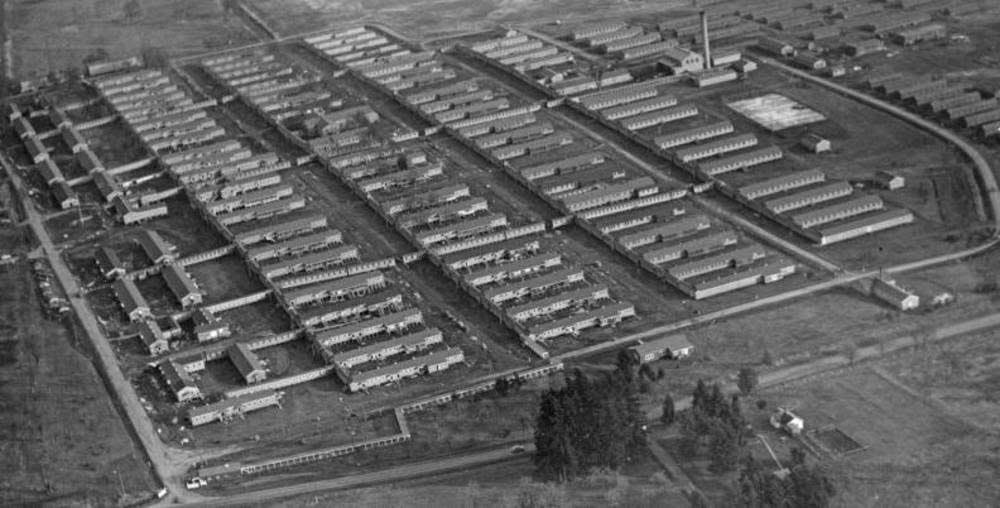
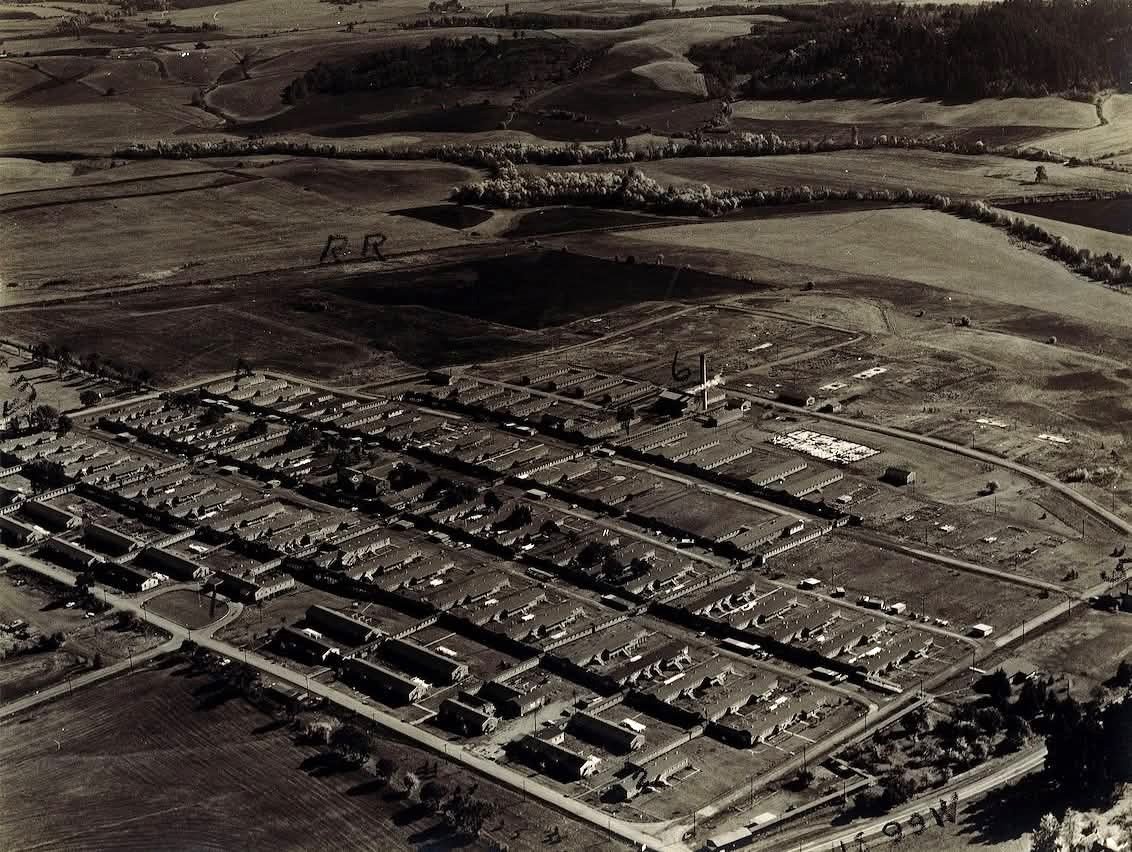
When Camp Adair rose from the fields of the Willamette Valley during World War II, it was more than a training camp. It was a temporary military city, with thousands of soldiers arriving from across the United States. Among the most important facilities in that city was the Camp Adair Station Hospital, located south of the main cantonment. The hospital served as a critical part of the camp's medical system, caring for soldiers who became sick or injured during training and preparing Army medical personnel for the demands of a global war.
Camp Adair was constructed with remarkable speed beginning in 1942. In April 1942 while under construction the Hospital got the water turned on. The enormous installation eventually contained more than 1,400 buildings in the main cantonment, while the hospital complex represented another major concentration of buildings. At the height of the camp's activity, roughly 40,000 people could be associated with Camp Adair at one time.
A Hospital for a Wartime Army
The Station Hospital was responsible for the medical care of the soldiers training at Camp Adair. These men were preparing for combat, and their training was demanding. Soldiers marched long distances, handled weapons and vehicles, practiced field exercises, crossed rivers, dug defensive positions, and trained under conditions intended to prepare them for combat overseas.
The hospital therefore dealt with much more than battlefield wounds. It treated the ordinary illnesses, injuries, accidents, and medical problems that accompanied the operation of a huge wartime training center.
The hospital also worked closely with the Medical Detachment and other medical personnel stationed at Camp Adair. Contemporary records show that the Station Hospital provided medical and dental care beyond the services available through smaller infirmaries and dispensaries.
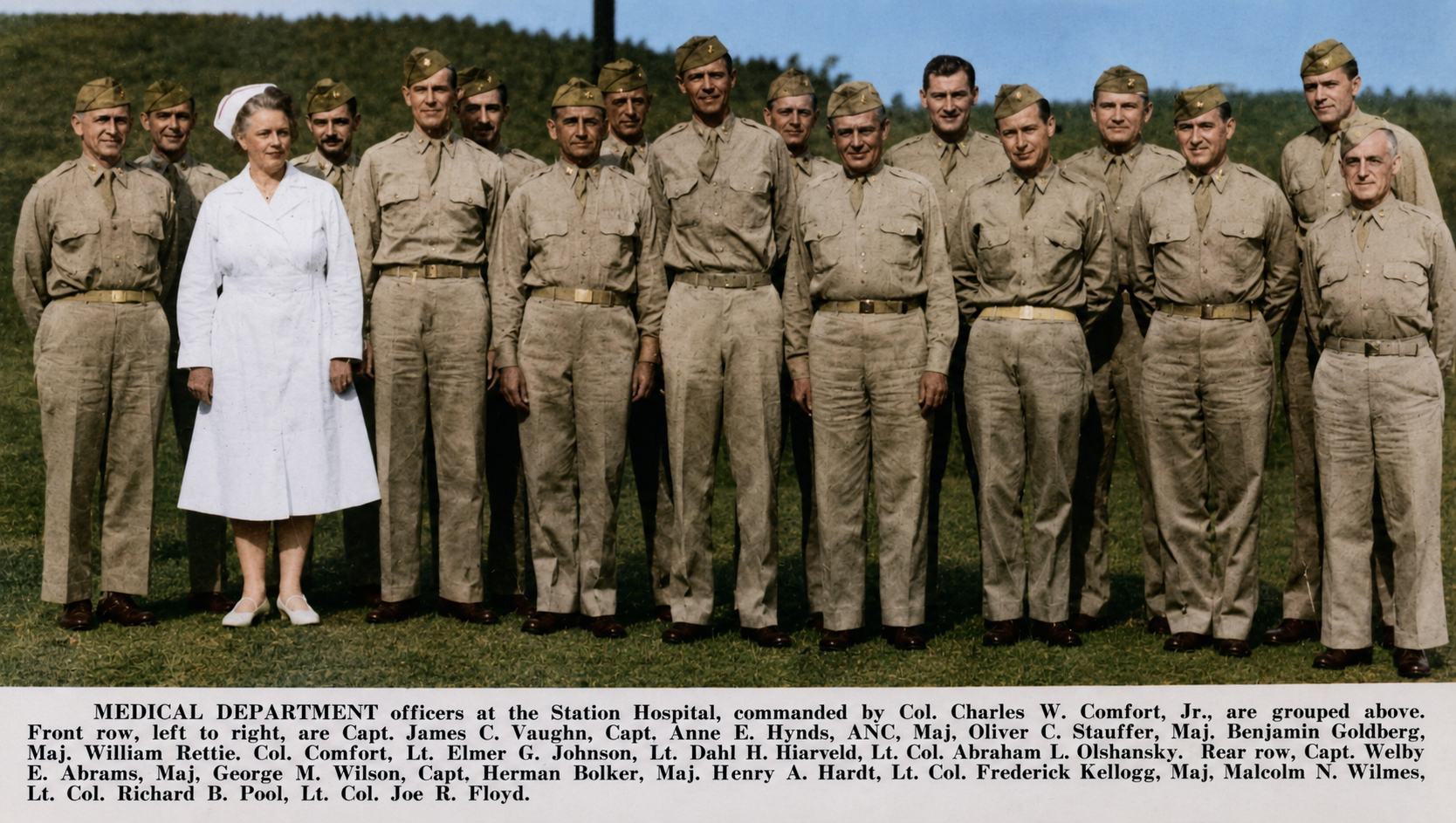
The first commander was assigned in October, 1942 Col William Lewis. The seconded commander replaced Col Lewis in July, 1943 Col Charlies Comfort. Early issues of the Camp Adair Sentry talked about the 253d Station Hospital, in the October 22, 1943 issue of the Sentry, the 236th Station Hospital was mentioned.
Nurses Trained Like Soldiers
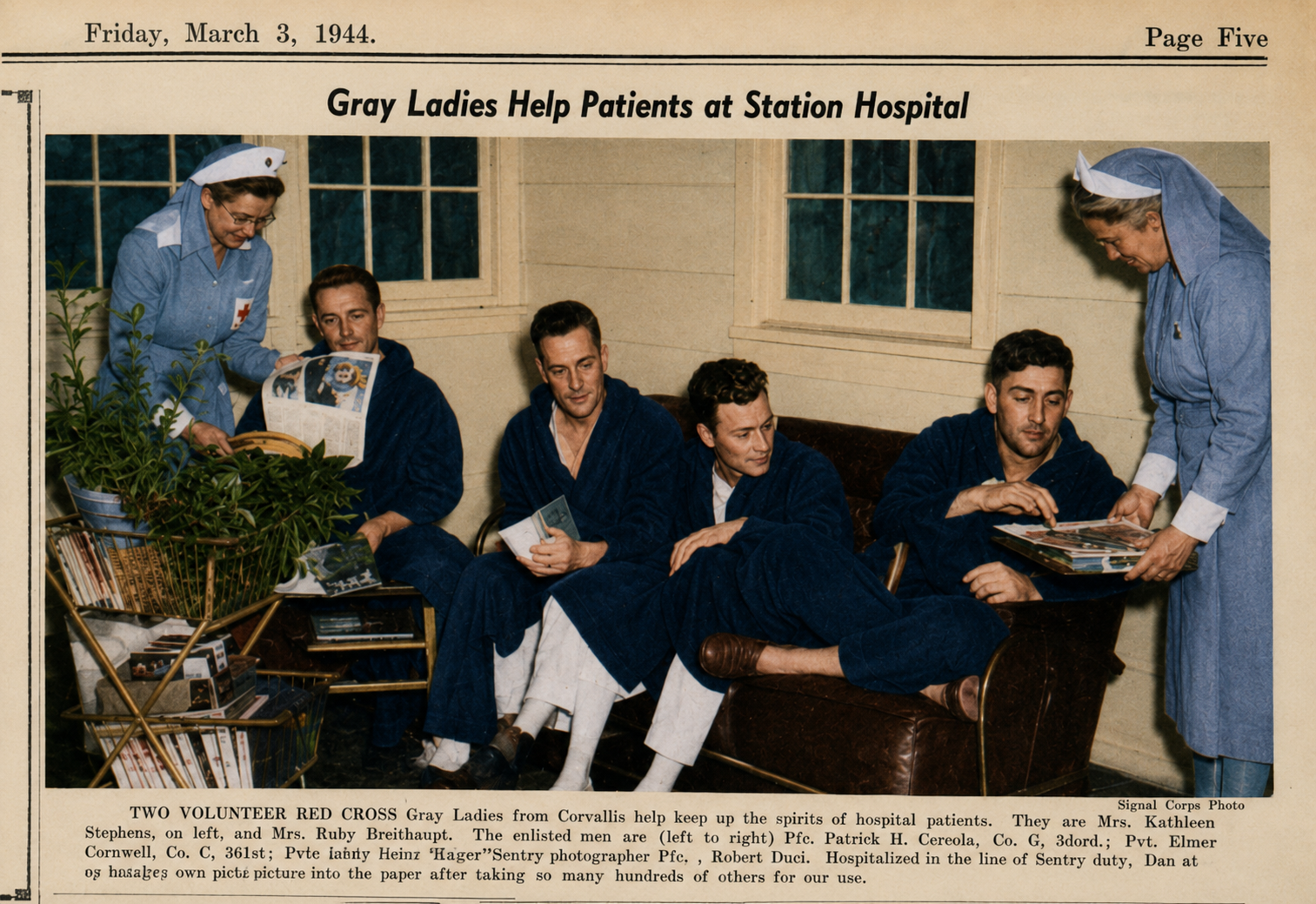
The nurses who worked at Camp Adair were an important part of the hospital's wartime operation. They were not simply medical workers remaining behind the lines. The Army expected its nurses to be prepared for the dangers and hardships of wartime service.
A June 1943 article in the Camp Adair Sentry described Station Hospital nurses undergoing an intensive basic-training program. They marched in military fatigues and GI shoes, participated in close-order drill, went on long hikes, and received gas-mask instruction. Some of the nurses were even completing six-mile hikes as part of their training.
This training reflected the reality of World War II: even medical personnel had to be prepared to operate under military conditions.
Blood Transfusions and Emergency Care
The Station Hospital also had the capability to provide emergency medical treatment. A 1943 Camp Adair Sentry report described blood transfusions being supplied by members of the Medical Detachment. Because the medics were readily available and underwent regular testing, they served as volunteer donors when blood was needed.
The newspaper gave an example of the hospital's emergency capability, reporting that an injured officer received a transfusion within approximately ten minutes of arriving at the hospital.
Behind a statistic like that were Army doctors, nurses, medics, laboratory personnel, orderlies, ambulance crews, and other workers whose jobs were to make sure that medical care was available when a soldier needed it.
More Than a Place for the Sick
A wartime military hospital was also part of the larger training and support system of the Army. Camp Adair's medical personnel supported soldiers before they ever reached the battlefield.
Medical officers and enlisted medics participated in camp activities, while nurses received military training of their own. The hospital also worked with other institutions in the region. Records from 1943 show arrangements involving medical services for Army personnel at Oregon State College, while the Station Hospital remained available for medical and dental care beyond the college's own services.
The hospital was therefore connected to the broader military community surrounding Camp Adair and Corvallis.
From Army Hospital to Navy Hospital
The most dramatic change in the hospital's history came as Camp Adair's role as an infantry training center began to wind down.
By 1944, the Army's major infantry divisions that had trained at Camp Adair were moving toward overseas combat. Instead of simply closing the hospital with the rest of the training camp, the facility was expanded and given a new mission.
The hospital was enlarged to a capacity of approximately 3,600 patients and transferred to the United States Navy for the treatment of sailors and Marines wounded in the Pacific Theater.
The hospital thus continued serving the war effort even after Camp Adair's infantry-training mission had largely ended.
The former Army hospital was formally commissioned as the U.S. Naval Hospital, Corvallis, on February 3, 1945. It remained in operation until May 31, 1946.
The Hospital Complex
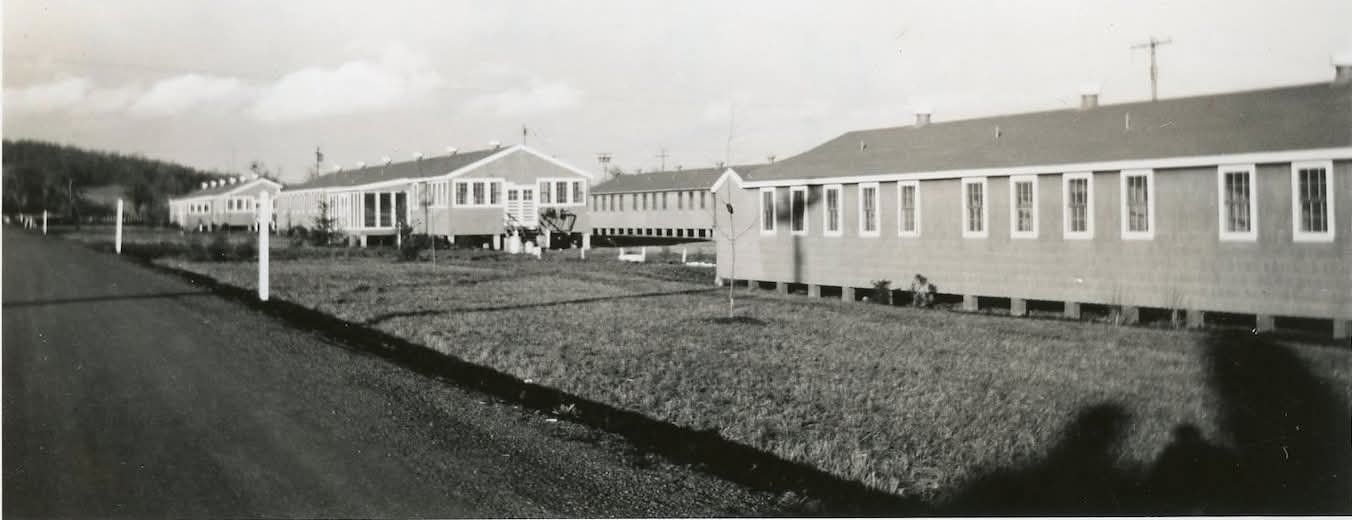
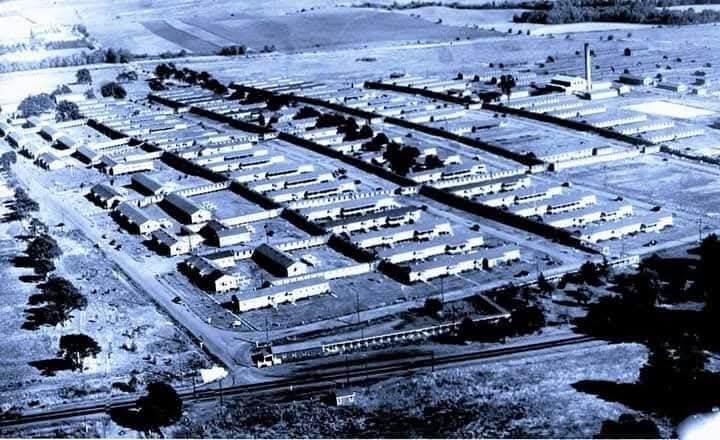
The hospital was not a single building. It was a large medical complex containing numerous ward buildings and support facilities. Historic documentation identifies ward units, an administration building, nurses' quarters, a fire station, and a heating plant among the complex's facilities.
The scale of the complex reflected the enormous number of men passing through Camp Adair and, later, the need to care for casualties returning from the Pacific.
For the soldiers who entered through its doors, however, the hospital was not simply another group of military buildings. It was a place where they were examined, treated, recovered, and sometimes sent back to their units.
A Lasting Part of Camp Adair's History
After World War II, most of Camp Adair's temporary buildings were removed, sold, or moved to other locations. The hospital area was different. Because of its size and usefulness, portions of the hospital complex survived and were later adapted for civilian use.
After the war, Oregon State University leased the former hospital facilities and converted the wards into apartments for students and faculty during the postwar housing shortage. The community that developed around the former hospital eventually became Adair Village.
Today, several remnants of the hospital complex survive, including altered ward buildings and the large smokestack associated with the former heating plant.
The Camp Adair Station Hospital represents an important part of the story that can sometimes be overlooked when remembering the camp. Camp Adair is remembered primarily for the four infantry divisions that trained there and went on to fight overseas. But behind those soldiers stood an enormous support organization, doctors, nurses, medics, orderlies, ambulance crews, cooks, maintenance workers, and countless others.
236TH MEDICS DEMONSTRA TE FITNESS AND INGENUITY IN ARMY TRAINING
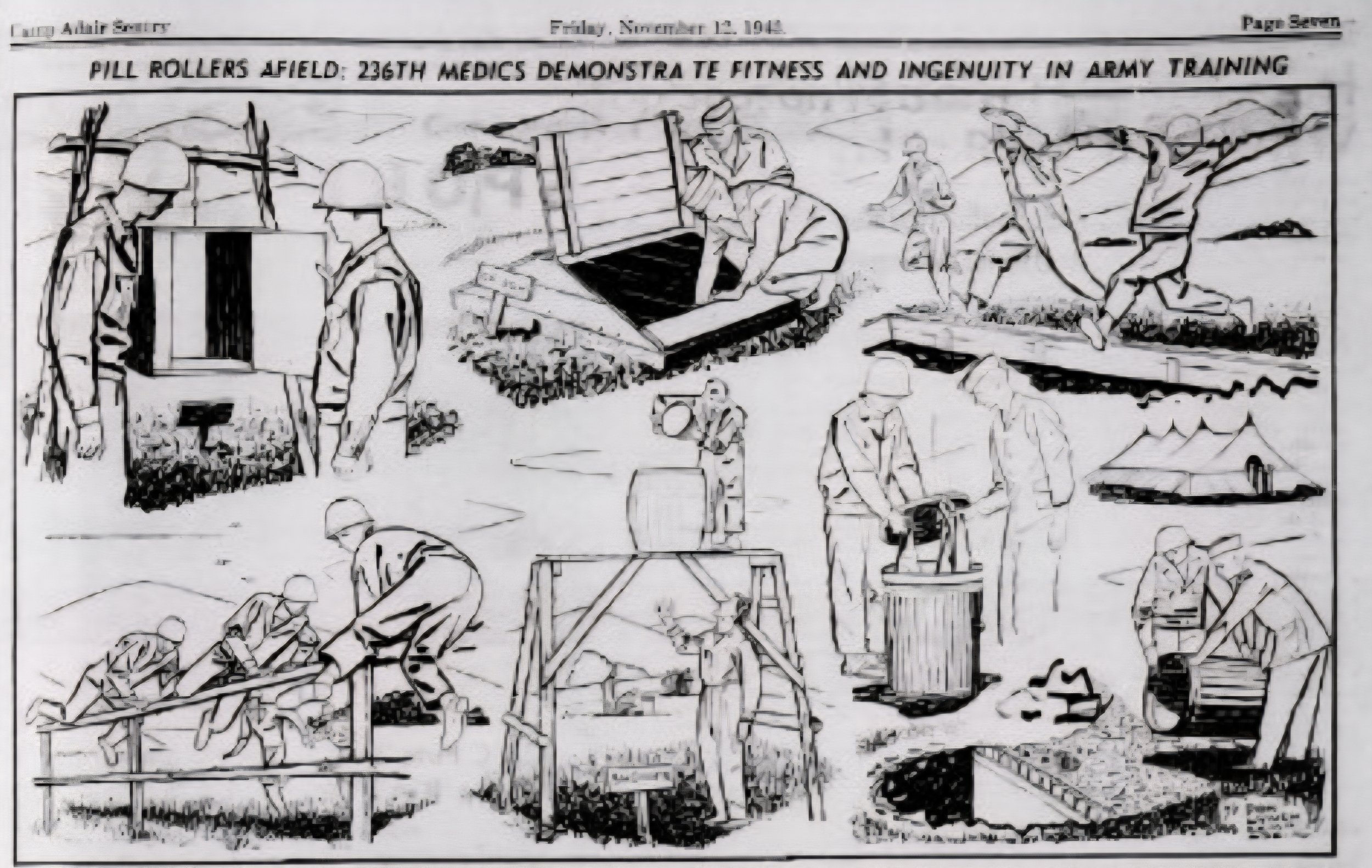

Men of the 236th Station Hospital inspect the “ice box” for the upcoming training.
 A photographic record made with the cooperation of officers
and enlisted men at 236th Field Hospital, the above dramatic drawings explain a few simple methods used to maintain health and fitness where an absolute minimum of conveniences are available. Men of the 236th have in effect constructed their own
obstacle course to speed up fundamentals in field training.
Reading from left to right, the first illustration shows an elevated, screened food storage box which is simply and quickly constructed but provides protection from ground animals and insects. Next is an "ice box"; it uses no ice except the insulating
qualities of Mother Earth, which effectively protects perishables. The "water jump" (third photo) is used in getting physical fitness. Fourth, with a raised platform, old barrel, spray nozzle and (we hope) water, an effective shower is built. The next pictures portrays what is called a "Serbian barrel.” Some call it delouser. Water is heated in the low end of the can. producing steam brought in direct contact with clothing to be cleansed. The lower right photo shows an incinerator designed for
field use. which can be constructed wherever rock and gravel are available. The Field Hospital tent (right center) has a normal capacity of 20 beds and is used for training purposes by men of the 236th. Cooperating in the field workout for the Sentry series
were the following enlisted men; T/5 h Kenneth Bolton. Harry Rvan. Duncan Rigney, Arthur L. Johansen. CpIs. Robert E. Green, Leo F. Ilammersky, Russell Jensen. Pvts. Louis E. Austin. Peter l.odato. Lew Arkin. Herman P. /Adams and Pfc. Milo Kuhn.