
Meet the Dogs, Mascots, and Animal Companions at Camp Adair
The wartime camp had another group of residents that did not wear uniforms, carry rifles, or answer to reveille, dogs and other animals that became working partners, mascots, and familiar friends to the men stationed there.
Some were officially part of the Army. Others simply wandered into camp life and were adopted by soldiers or individual units. For many servicemen, these animals provided companionship and a reminder of home during the long months of training.
Dogs became so common around Camp Adair that the Army eventually had to establish rules concerning them.
In April 1943, the Camp Adair Sentry reported that there were many stray dogs on the post and that authorities wanted them picked up. Soldiers who wanted to keep a dog at Camp Adair had to have it immunized, at a cost of one dollar per year.
Dogs were also prohibited from certain areas, including the hospital, exchanges, service clubs, cafeterias, and other buildings where food was stored, prepared, or eaten. During certain hours they had to be restrained.
The rules did not mean the Army had no room for canine companions. In fact, the Sentry reported that a half-Chow dog wanted to "join the Army." The catch was that the Army would not simply enlist an individual dog. The animal had to be adopted as the mascot of a military organization.

Sgt. Raoul Mound
Camp Adair was one of the Army installations that received trained military dogs during World War II. In November 1942, the Camp Adair Sentry announced that 24 "dogs of war" were expected to enter service at Camp Adair with the Military Police of Service Command Unit 1911. The dogs were being obtained through Dogs for Defense, Inc., a civilian organization established to help the Army acquire suitable dogs for military service.
Three enlisted men were assigned to supervise and care for the animals: Sargent Raoul Mound, Corporal Nicholas A. Paolucci, and Corporal John P. Schoenrock. The dogs were highly trained and were considered an important addition to the camp's security forces.
The Army had learned that a trained dog could greatly increase the effectiveness of a guard. Military authorities estimated that one man working with a trained dog could perform the work of approximately eight sentries. At a huge installation like Camp Adair, with ammunition storage areas, warehouses, training grounds, gates, and other restricted areas, the usefulness of these animals was obvious.
These were not simply pets wearing Army collars. They were working military animals, trained to perform duties that could help protect the post.
The Army's "Dogs of War"
Ginger the Gift - But No Pep
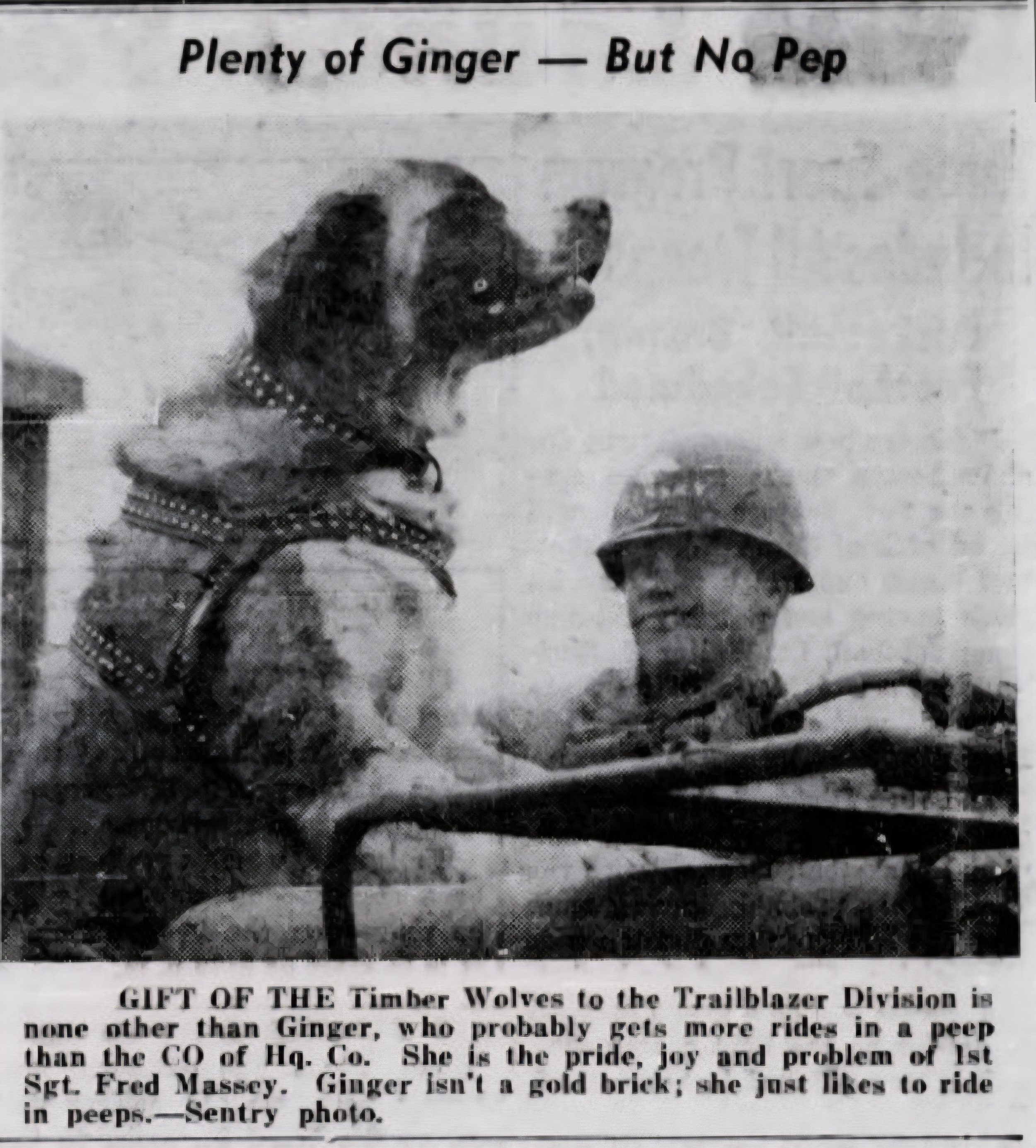
Another famous Camp Adair mascot was Ginger. Ginger was a gift from the Timber Wolves. She associated with Division Headquarters Company of the 70th Division. Ginger was described as a large, somewhat Saint Bernard dog who became a familiar sight to the Trailblazer soldiers. A photograph shows Ginger riding around Camp Adair in a jeep with 1st Sgt. Fred Massey.
Blazer—the Dog Who Went AWOL
One of Camp Adair's most memorable military dogs was Blazer, a handsome brown-and-white collie.
Blazer became famous around Camp Adair in June 1943 when he decided to leave his assigned area without permission. He disappeared on June 22 and returned four days later, earning himself the dubious distinction of becoming the first "Dog O'War" at Camp Adair to face a court-martial.
The Sentry treated the incident with the same humor it used for many of the soldiers' stories. A mock military court was assembled beneath the apple trees in the K-9 detachment area. Sgt. Nicholas Paolucci, one of the camp's dog trainers, brought Blazer before Lt. William H. Gill, who acted as judge.
Blazer was charged with being absent without leave. After his "trial," he was ordered to remain confined to the post until arrangements could be made to transfer him to another training ground.
The story became one of the colorful episodes of Camp Adair history. Newspapers around Oregon even picked up the story of the missing military dog.
For the soldiers who knew him, Blazer was more than a trained guard animal. He had become a recognizable character around the post.
Stinky—The Tent City's Mascot
Long before Camp Adair was fully built, there were already dogs wandering around the temporary Tent City.
One of them was remembered by the Sentry as Stinky, a camp mascot from the early days of Camp Adair. In the newspaper's first-anniversary reminiscences, soldiers recalled Stinky and the trouble that accompanied keeping the dog around Tent City.
Stinky apparently became something of a local celebrity among the early Camp Adair personnel. The newspaper even joked about the soldiers who had to deal with the dog's antics.
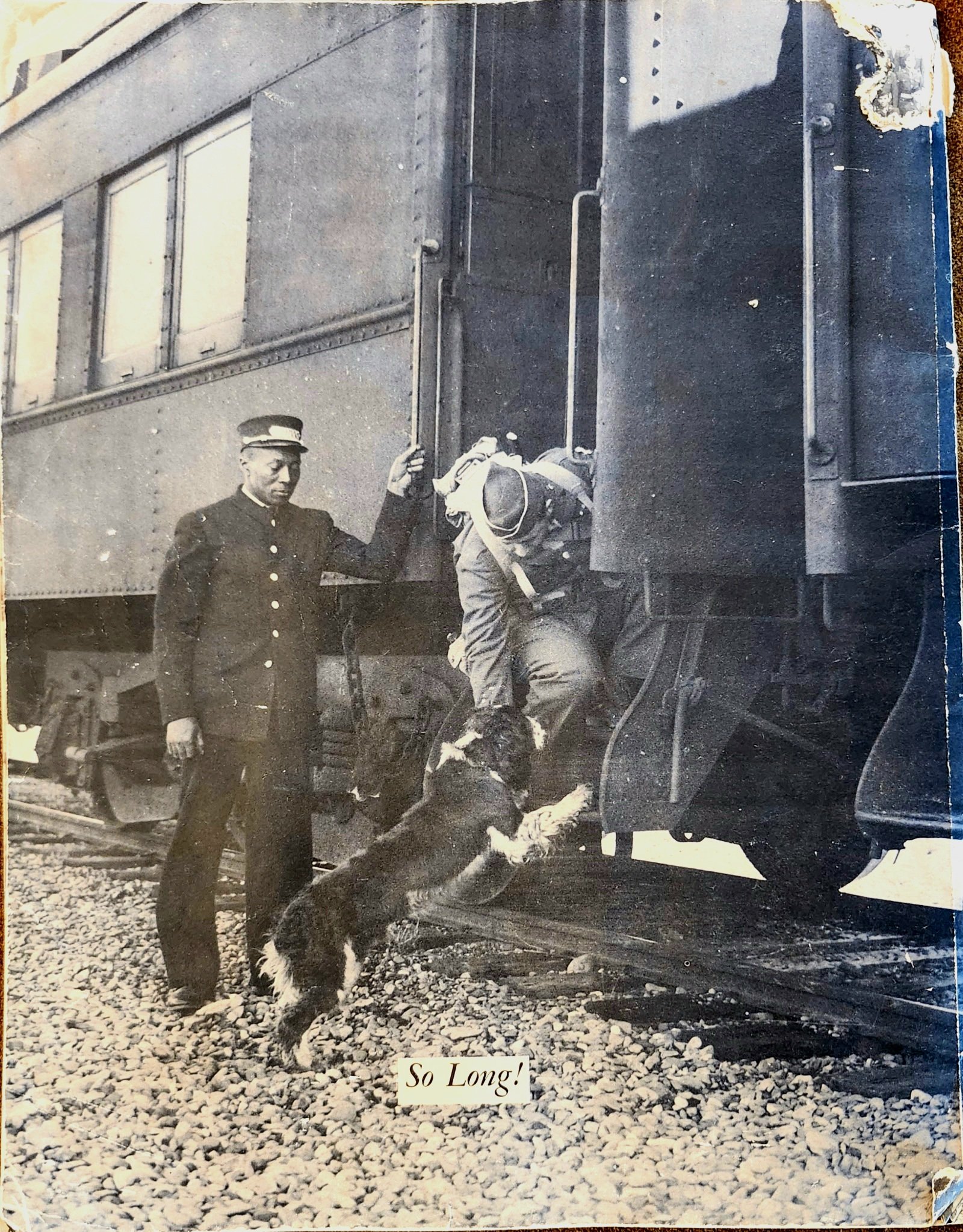
Stories such as Stinky's show that not every Camp Adair animal had an official military assignment. Some simply became part of the community.
Unit Mascots
Mascots were an important part of military life during World War II.
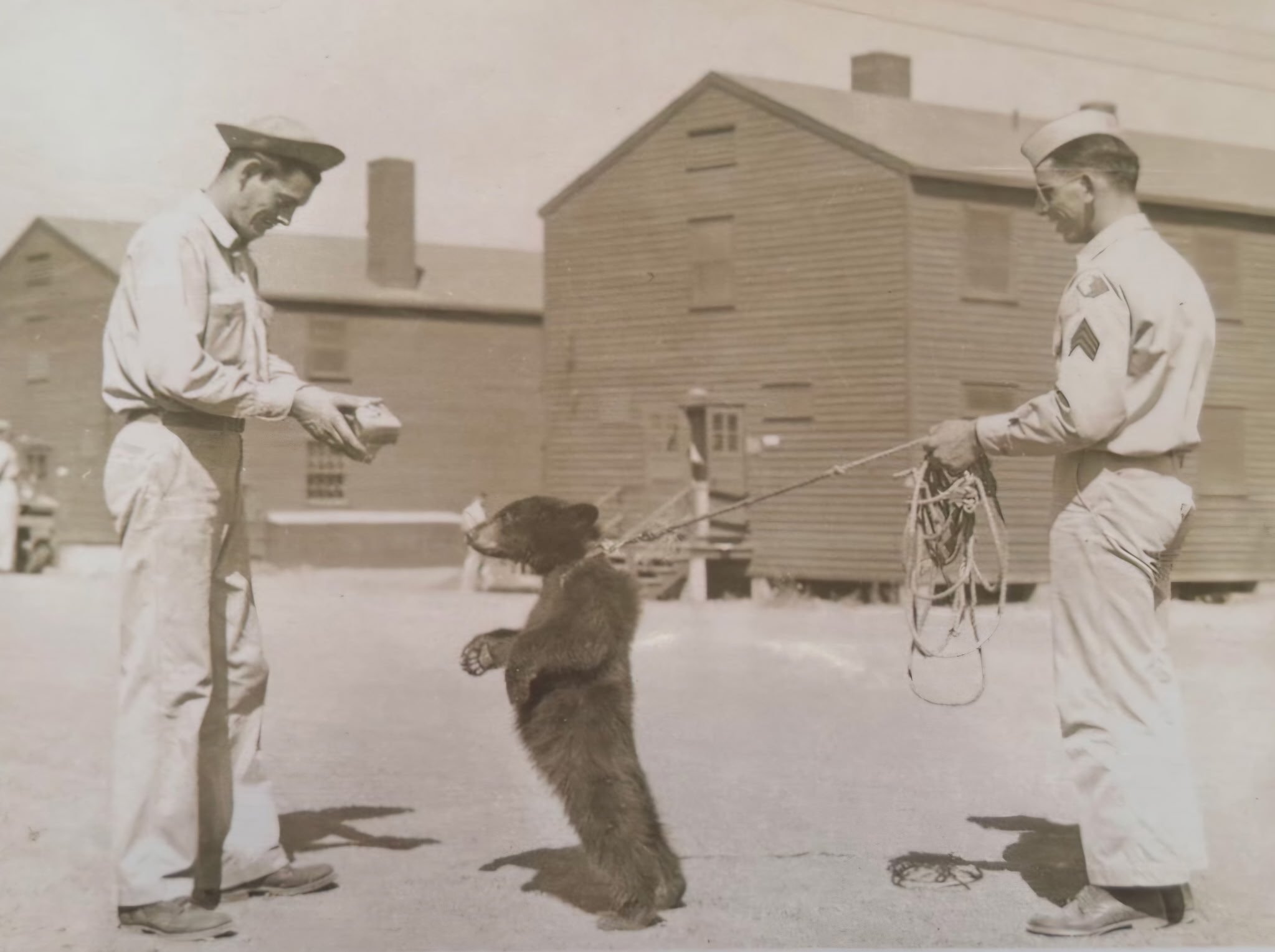
A unit mascot could be a dog, cat, bird, or another animal that became associated with a particular company, headquarters, band, or other organization. Unlike official military working dogs, mascots were generally there for companionship and morale.
Camp Adair had its share of these unofficial members of military organizations.
One documented example was Sonny, the mascot of the 70th Division band. A 1943 photograph of the band identifies Sonny sitting on the ground with the musicians.
Another famous Camp Adair mascot was Ginger, associated with Division Headquarters Company of the 70th Division. Ginger was described as a large, somewhat Saint Bernard dog who became a familiar sight to the Trailblazer soldiers. A photograph shows Ginger riding around Camp Adair in a jeep with 1st Sgt. Fred Massey.
For the men of the division, animals like Ginger and Sonny were not just curiosities. They became part of the personality of their units.
.