
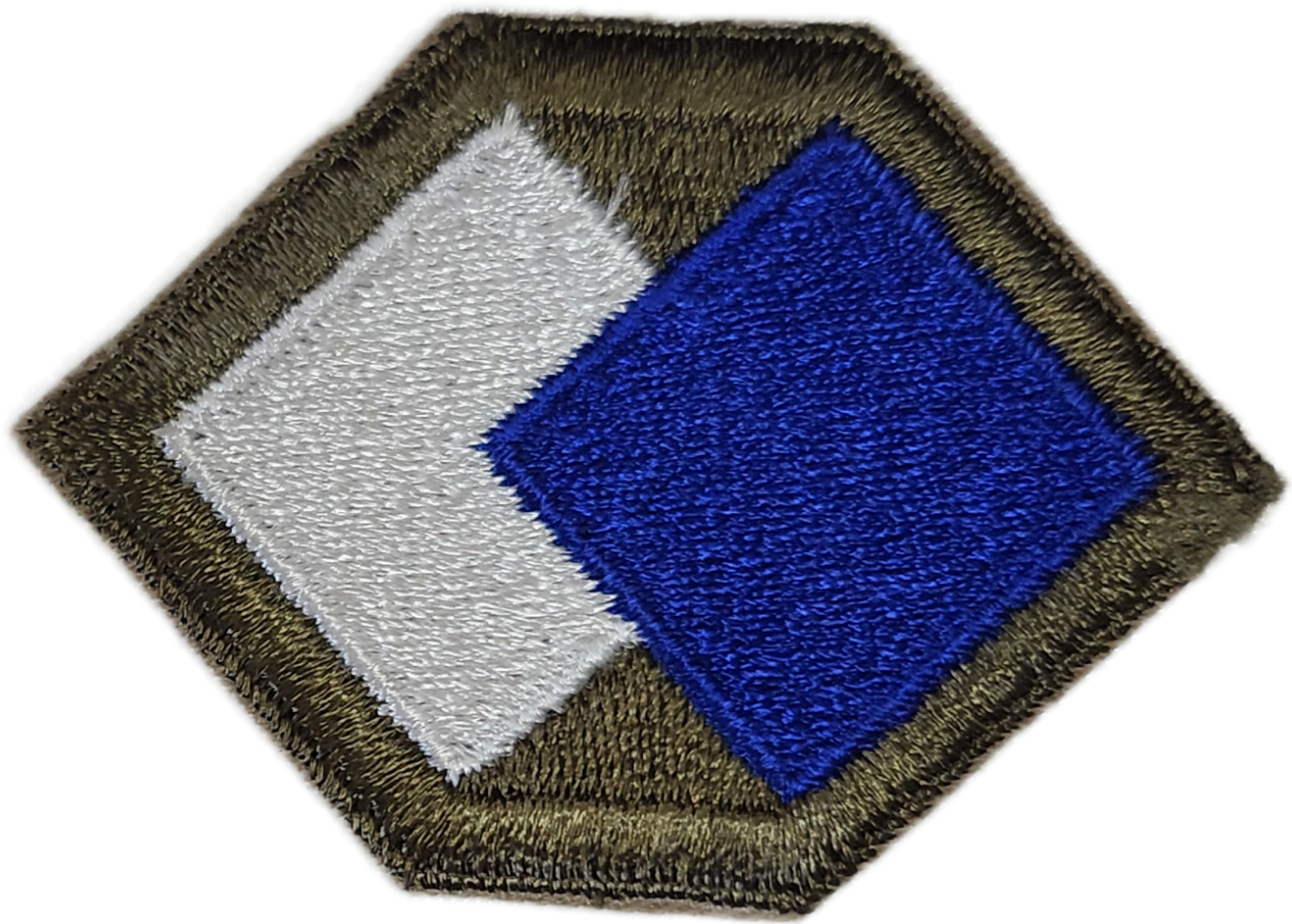
96th Infantry Division “Deadeyes”
From Camp Adair to Leyte and Okinawa, 1942–1946
The 96th Infantry Division holds a special place in the history of Camp Adair. It was the first infantry division activated at Camp Adair, and its soldiers spent much of their early wartime training in Oregon. They trained believing they might eventually fight in Europe, only to find themselves sent to the Pacific. There they fought two major campaigns—Leyte in the Philippines and Okinawa—and became one of the most experienced American infantry divisions of the Pacific war.
The story of the 96th is therefore also the story of how Camp Adair prepared an American division for a war that ultimately took it halfway around the world.
Origins of the Division
The 96th Infantry Division had its origins in World War I. It was constituted in September 1918 and organized at Camp Wadsworth, South Carolina, but the First World War ended before the division could reach France. It was subsequently demobilized.
The division was reconstituted in the Organized Reserves in 1921, with its headquarters in Portland, Oregon. Its home area included Oregon and Washington, and the division became known as the Columbia Division, reflecting its connection to the Pacific Northwest.
When the United States entered World War II, the Army began bringing its Organized Reserve divisions into active service.
For the 96th, that call came on August 15, 1942.
Activated at Camp Adair
On August 15, 1942, the 96th Infantry Division was activated at Camp Adair, Oregon, under the command of Major General James L. Bradley. Bradley would command the division throughout its entire World War II service.
The activation of the 96th was one of the first major milestones in Camp Adair's history.
The camp itself was still being developed. Construction had begun following the decision to establish a massive training center in the Willamette Valley. Eventually, Camp Adair would contain more than 1,700 buildings and provide facilities for tens of thousands of soldiers.
The 96th became the first division in Camp Adair's northern training area.
The division was reorganized under the Army's new triangular division structure. Instead of four infantry regiments, it would have three:
381st Infantry Regiment
382nd Infantry Regiment
383rd Infantry Regiment
Its principal artillery units eventually became:
361st Field Artillery Battalion
362nd Field Artillery Battalion
363rd Field Artillery Battalion
921st Field Artillery Battalion
Other major organizations included the 321st Engineer Combat Battalion, 321st Medical Battalion, 96th Reconnaissance Troop, signal, quartermaster and ordnance units.
Building the “Deadeyes”
The division's early training at Camp Adair was intense.
Thousands of men arrived, many of them draftees with little or no previous military experience. They had to be transformed into soldiers capable of fighting as part of a modern infantry division.
One of the division's most important training programs centered on marksmanship.
Brigadier General Claudius M. Easley, the assistant division commander, was an accomplished marksman and placed extraordinary emphasis on rifle training. Soldiers were expected to become expert with their weapons.
The effort paid off.
The 96th developed a reputation for exceptional marksmanship and acquired its famous nickname:
“Deadeyes.”
That reputation would follow the division all the way to the Pacific.
Training at Camp Adair
The soldiers trained in virtually every aspect of infantry warfare.
They practiced:
Rifle and machine-gun marksmanship
Mortar and artillery coordination
Map reading
Field communications
Patrolling
Camouflage
Field fortifications
Combat tactics
Night operations
Large-scale maneuvers
The division's training was not limited to the barracks and parade grounds. Camp Adair provided an enormous maneuver area where entire regiments and divisions could operate in the field.
The 96th's training eventually expanded beyond Camp Adair.
On May 10, 1943, the division moved to Fort Lewis, Washington, for additional training. In July it moved to the Oregon Maneuver Area near Bend. After returning briefly to Camp Adair, it participated in the large IV Corps maneuvers in central Oregon alongside the 91st and 104th Infantry Divisions.
In November 1943 the division moved to Camp White, Oregon, where it continued its preparation for combat.
Thus, although Camp Adair was the division's birthplace, its training story involved much of the Pacific Northwest.
Preparing for Overseas Combat
By early 1944, the 96th was undergoing a major transformation.
The division was brought up to full strength with thousands of additional soldiers, including approximately 2,000 men from the Army Specialized Training Program after that program was curtailed. Aviation cadets and other personnel were also incorporated into the division.
Then came an important clue about the division's future.
The 96th was designated an amphibious division.
That meant its soldiers would have to learn how to attack an enemy-held coastline from landing ships and assault boats.
In April 1944 the division left Oregon for Camp San Luis Obispo, California.
Amphibious Training in California
At Camp San Luis Obispo, the Deadeyes began intensive amphibious training.
The men practiced loading and unloading landing craft, moving from ships to beaches, organizing assault waves and fighting their way inland after a landing.
Individual regiments also conducted specialized practice landings.
At the time, many soldiers suspected that their destination would be the Pacific.
They were correct.
The division completed its California training in the summer of 1944 and moved to Camp Beale and then Camp Stoneman, California, where it prepared for overseas movement.
On July 23, 1944, the division began sailing from the San Francisco Port of Embarkation.
Its destination was Hawaii.
Hawaii
The 96th arrived in Hawaii in late July 1944.
The division established itself on Oahu, including Schofield Barracks, while the 381st Infantry occupied positions in the Pali area.
The Deadeyes now entered another phase of training.
They practiced:
Jungle warfare
Amphibious operations
Ship-to-shore movement
Beach assaults
Combat under tropical conditions
In September, portions of the division conducted practice amphibious landings on Maui.
The division was preparing for an operation against the Japanese-held island of Yap.
The planned invasion was scheduled for October 1944.
But the Pacific war was moving rapidly.
And the destination changed.
The Change to Leyte
While the 96th was at sea, its mission changed.
Instead of invading Yap, the division would participate in the American return to the Philippines.
The new objective was Leyte Island.
The operation was designated KING II.
The landing date was set for:
October 20, 1944.
For the men of the 96th, this meant that nearly two years of training had finally reached its purpose.
They were going into combat.
Leyte
On October 20, 1944, the 96th Infantry Division landed on the eastern coast of Leyte as part of General Douglas MacArthur's return to the Philippines.
The division's soldiers came ashore on the invasion beaches alongside other American forces.
The initial landing was successful, but the campaign that followed was anything but easy.
The Japanese had established defensive positions throughout the island, particularly in the mountainous interior.
The Deadeyes now faced a completely different environment from Camp Adair.
The Oregon soldiers were fighting in tropical rain, mud and dense vegetation.
Roads were poor.
The terrain was difficult.
Disease was a constant concern.
Japanese resistance could be fierce.
The 96th fought its way inland and into the mountains of Leyte.
Among its major battles was the fighting for Breakneck Ridge, one of the division's most famous actions.
Breakneck Ridge
The terrain around Breakneck Ridge was steep, heavily forested and extremely difficult to attack.
Japanese forces had established defensive positions that took advantage of the mountains and jungle.
The 96th attacked repeatedly.
The fighting became some of the hardest combat experienced by the division.
Soldiers had to advance up steep slopes while facing machine-gun fire, mortar fire and concealed Japanese positions.
The Deadeyes eventually broke through the Japanese defenses.
The victory opened the way for further advances across Leyte.
The division continued fighting until the Japanese resistance on Leyte was largely defeated.
The campaign demonstrated the value of the division's training.
The marksmanship emphasized by General Easley at Camp Adair was now being tested against an enemy that often fought from concealed positions.
From Leyte to Okinawa
The 96th remained in the Philippines following the Leyte campaign.
The division had entered combat in October 1944.
By early 1945, however, the next operation was already being planned.
The destination was Okinawa.
Okinawa was different from Leyte.
The island was much closer to the Japanese home islands and was heavily defended.
The Americans knew that the fighting would be extremely difficult.
The 96th would once again make an amphibious landing.
But this time, the enemy would be waiting in strength.
Okinawa — April 1, 1945
On April 1, 1945, the 96th Infantry Division landed on Okinawa as part of the opening of Operation Iceberg.
The invasion was one of the largest amphibious operations of the Pacific War.
The 96th came ashore with the 7th Infantry Division on the western coast of Okinawa.
Initially, the American advance inland was relatively rapid.
The Japanese had chosen not to concentrate their strongest defenses directly on the beaches.
Instead, they had constructed a series of heavily fortified defensive positions farther inland.
The Deadeyes were about to encounter one of the most formidable defensive systems of the Pacific War.
Kakazu Ridge
The fighting at Kakazu Ridge became one of the defining episodes in the history of the 96th Infantry Division.
The Japanese had fortified the ridges with caves, bunkers, machine guns, mortars and artillery.
The American attack became extremely difficult.
The 96th suffered heavy casualties while trying to seize the ridge.
The battle demonstrated the character of the Okinawa campaign: progress was measured in yards rather than miles.
Soldiers who had trained together at Camp Adair were now fighting for individual hills and ridgelines.
The division continued attacking despite fierce resistance.
General Easley's Death
One of the greatest tragedies for the 96th occurred during the Okinawa campaign.
Brigadier General Claudius M. Easley, who had played such an important role in transforming the division into the “Deadeyes,” was killed in action on June 19, 1945.
His death was a devastating loss.
Easley had been with the division since its activation at Camp Adair.
He had personally driven the marksmanship program that had given the division its nickname.
The soldier who had helped shape the Deadeyes from their earliest days in Oregon died on the battlefield of Okinawa only weeks before the Japanese surrender.
The End of the Okinawa Campaign
The fighting on Okinawa continued through June.
The 96th participated in the final operations that broke Japanese resistance on the island.
The campaign officially ended in June 1945.
For the Deadeyes, nearly three years of training and combat had taken them from the fields of Oregon to the mountains and beaches of the Pacific.
They had fought in two of the major campaigns of the Pacific war:
Leyte
and
Okinawa.
The division had spent approximately 200 days in combat during World War II and suffered 1,563 killed in action and approximately 8,800 total casualties.
After Okinawa
After the fighting ended, the 96th remained in the Pacific.
The division returned to the Philippines in July 1945 and was stationed there when Japan surrendered in August.
The men of the Deadeyes had expected another operation against Japan itself.
The invasion would never happen.
The atomic bombings of Hiroshima and Nagasaki, followed by Japan's surrender, brought the Pacific War to an end.
For the 96th, this meant that the next mission would be demobilization and returning home rather than another bloody invasion.
Returning Home
The division remained in the Philippines while preparations were made to return American soldiers to the United States.
In early 1946, the Deadeyes finally began their journey home.
The 96th returned to the United States on February 2, 1946.
The division was subsequently inactivated in February 1946, bringing its World War II history to an end.
The Journey of the Deadeyes
The wartime journey of the 96th Infantry Division can be traced across thousands of miles:
Camp Adair, Oregon
August 15, 1942
Activated and began building the division.
Fort Lewis, Washington
May–July 1943
Advanced combat training.
Central Oregon Maneuver Area
July–November 1943
Large-scale field exercises.
Camp White, Oregon
November 1943–April 1944
Additional training and preparation.
Camp San Luis Obispo, California
April–July 1944
Amphibious training.
Camp Beale / Camp Stoneman, California
July 1944
Final staging for overseas movement.
Hawaii
July–September 1944
Jungle and amphibious training.
Leyte, Philippines
October 20, 1944
First combat.
Breakneck Ridge / Leyte
October–December 1944
Heavy fighting against Japanese forces.
Okinawa
April 1, 1945
Amphibious invasion.
Kakazu Ridge and southern Okinawa
April–June 1945
Some of the division's hardest fighting.
Philippines
July 1945–January 1946
Occupation and preparation for return home.
United States
February 1946
Division returned and was inactivated.
The Legacy of the 96th at Camp Adair
The 96th Infantry Division's connection to Camp Adair is particularly important because Camp Adair was where the Deadeyes began their World War II journey.
The division arrived at a newly constructed Army installation in the Willamette Valley in August 1942.
The soldiers who walked through Camp Adair's barracks, mess halls, dayrooms and training areas were not yet veterans. Many were young men who had never been soldiers before.
They learned to fire the M1 rifle.
They learned to move as infantrymen.
They learned to work with artillery.
They learned communications, engineering, reconnaissance and medical procedures.
They trained in the Oregon rain and mud.
They conducted maneuvers throughout Oregon.
And eventually, they boarded trains and ships and traveled thousands of miles to the Pacific.
When they finally came ashore at Leyte in October 1944, they were no longer the inexperienced soldiers who had assembled at Camp Adair two years earlier.
They were the Deadeyes.
They fought through the jungles and mountains of Leyte.
They climbed the ridges of Okinawa.
They endured some of the bloodiest fighting of the Pacific War.
And when the war ended, the division's journey eventually brought its veterans home.
For the Camp Adair Legacy Project, the 96th Infantry Division represents one of the clearest examples of what Camp Adair was designed to accomplish.
The men came to Camp Adair as civilians and trainees.
They left as soldiers.
They crossed the Pacific and became combat veterans.
The foundations that remain at Camp Adair today therefore have a direct connection to Leyte, Breakneck Ridge, Okinawa and the final battles of the Pacific War.
The 96th was the first division activated at Camp Adair.
And its story is one of the longest journeys ever to begin there.