
Camp Adair’s Cavalry Patrol and Post Stables
By the summer of 1943, Camp Adair had become a vast military training center, with thousands of acres of training areas, ammunition storage sites, warehouses, roads, and other facilities spread across the installation. To help patrol and protect these widely scattered areas, Camp Adair established a small mounted cavalry unit.
Around July 1, 1943 Sentry, approximately 20 men and 35 horses were assigned to the mounted patrol. Their duties included patrolling the extensive Camp Adair training grounds, keeping watch over the ammunition dump and checking the numerous warehouses and other areas of the post. In an era before modern patrol vehicles and communications systems were as readily available as they are today, horses provided an effective way for soldiers to cover large areas of rough and undeveloped terrain.
Building the Post Stables
To support the new mounted unit, Camp Adair constructed a modern stable complex consisting of five buildings. The main stable contained 58 stalls, along with a saddle shop and access to a large open corral where the horses could be exercised and cared for.
The stable was designed with the welfare of the horses in mind. Its floor was constructed of concrete, while areas used by the horses incorporated a substantial layer of clay designed to provide a suitable surface and help protect their hooves. Proper care was essential because these horses were working animals and were an important part of the patrol's ability to perform its mission.
The complex also included facilities for maintaining saddles, tack, and other equipment required by the mounted patrol, plus storage buildings for hay and grain.
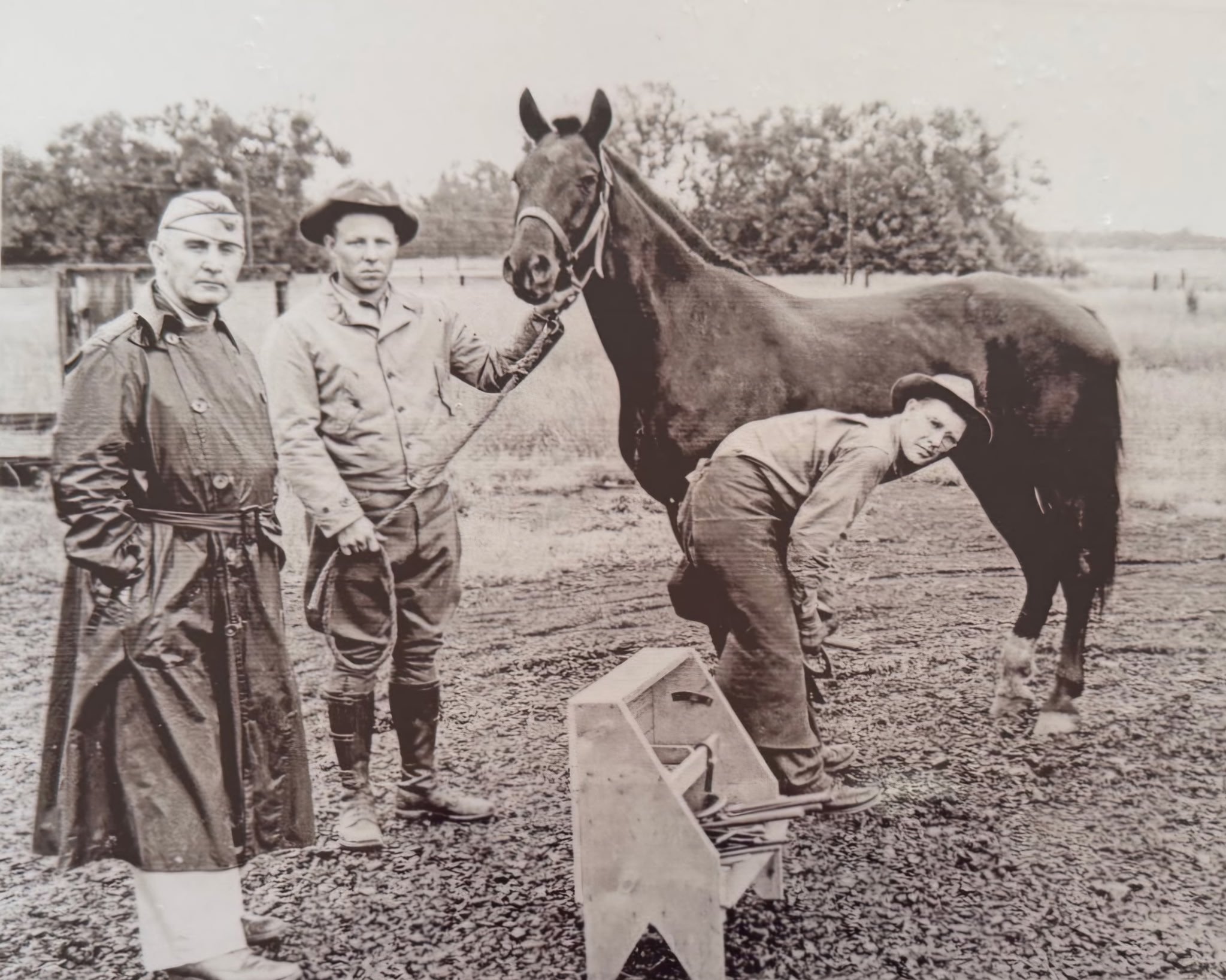
Lined up for “shoe-work,” is Pvt. Clarence King about to “nail or...” Standing by are Major J. H. Brandt, stable officer, and Pvt. .McWilliams
of the mounted platoon.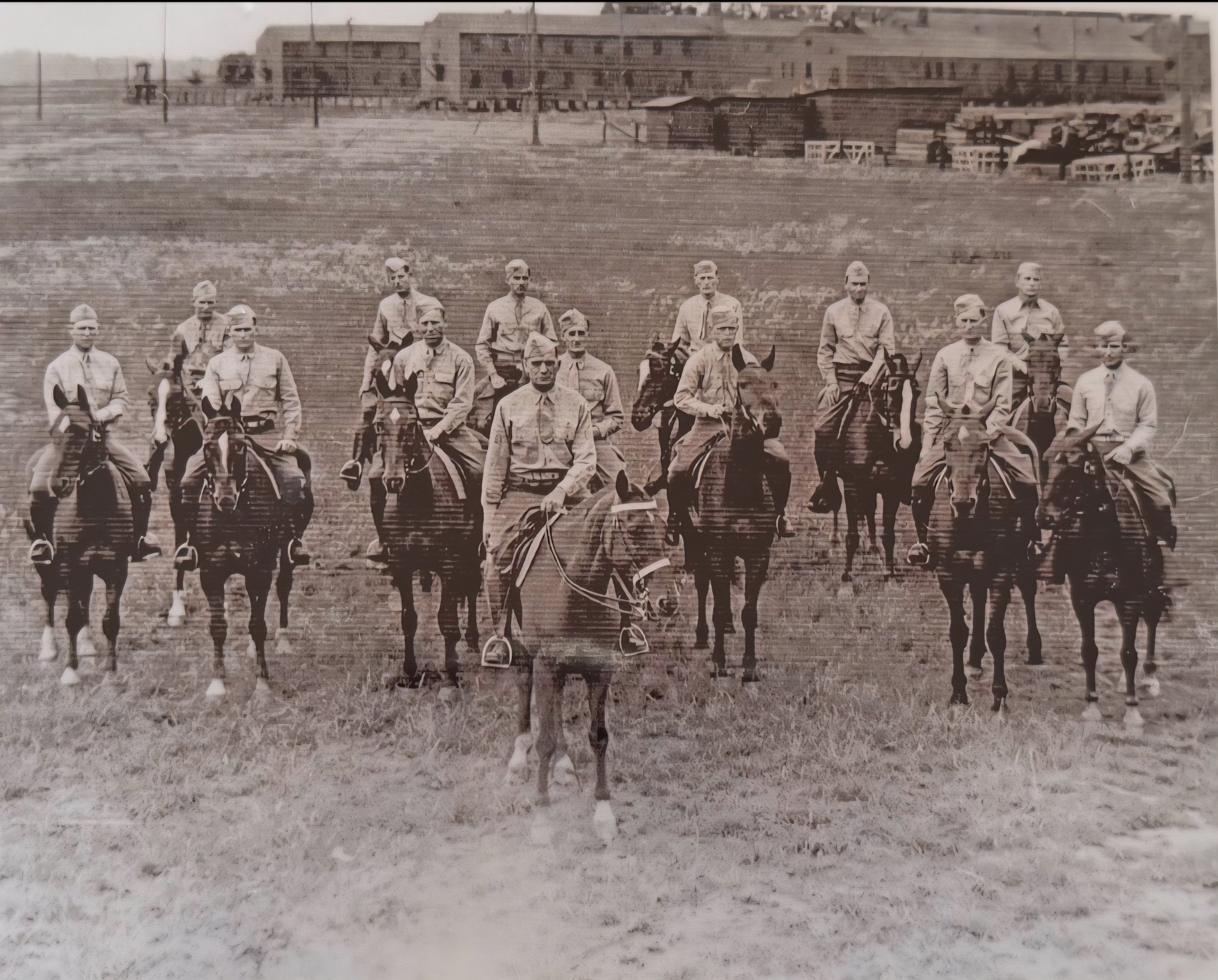
Fourteen of the men of the horse troop sadle up for a picture near the sables. Major J. H. Brant
The establishment of the mounted patrol was overseen by Major J. H. Brant, an experienced cavalryman. Before World War II, Brent had served with the 2nd, 3rd, and 7th Cavalry, bringing years of mounted-service experience to Camp Adair.
His cavalry background made him particularly suited to organizing and supervising the new operation. The mounted patrol represented a continuation of traditional Army cavalry methods at a time when mechanized transportation was rapidly changing the nature of military operations.
The Men Who Cared for the Horses
Behind the mounted patrol was a small group of soldiers responsible for keeping the horses healthy and ready for duty. Stable Sergeant MeKinley Stucker had quarters in a separate building immediately behind the stables, allowing him to respond quickly whenever an emergency arose.
A blacksmith shop was located to the rear of the stable complex. It provided a place where horses could receive necessary attention when they were sick, injured, or required specialized care.
Private Clarence King served as the unit's horseshoer. His work was especially important. A cavalry horse could not remain useful if its hooves were neglected, and proper shoeing helped keep the animals healthy and capable of carrying soldiers over Camp Adair's roads, fields, and training areas.
The stable personnel lived in a small community close to the stables, allowing them to reach the horses quickly when their services were needed.
A Small Cavalry Unit in a Modernizing Army
Camp Adair's mounted patrol was relatively small only about 20 men and 35 horses, but it served an important purpose. The horses gave the Army a practical means of patrolling the enormous Camp Adair reservation, particularly areas surrounding the ammunition dump, warehouses, and remote training grounds.
The unit also represented an interesting moment in military history. By 1943, the U.S. Army was rapidly becoming a mechanized force, yet horses had not disappeared from Army service. At Camp Adair, traditional cavalry skills continued to have a practical role alongside trucks, jeeps, armored vehicles, artillery, and other modern equipment.
For the soldiers and horses of this small mounted patrol, the stables were more than simply a place to keep animals. They were a working military facility, complete with stalls, a saddle shop, corral, blacksmith shop, and quarters for the men responsible for keeping the horses ready for duty.
Today, the remains of Camp Adair's stable area provide another reminder that the wartime camp was much more than barracks and training fields. Behind the thousands of soldiers preparing for combat was an entire support system, and among its most unusual elements was a small group of cavalrymen riding patrol across the vast wartime landscape.