A Soldier's Introduction to the United States Army, 1943
Based on Training Film TF 21-2067 and the equipment and procedures depicted in the film. For a young American entering the United States Army in 1943, military service began long before he ever reached a combat division. The process transformed a civilian into a soldier through a series of examinations, assignments, orientation, basic training, and eventually specialized and divisional training.
Training Film TF 21-2067 provides an excellent glimpse into this process. The equipment shown in the film represents the Army of approximately 1943. Soldiers are equipped with the M1 rifle, M1 steel helmet, and the then-standard 16-inch M1 bayonet. The film also shows the folding entrenching shovel, which was coming into use during this period.
Entering the Army
For many young men, the process began with the Selective Service System. A registrant would receive instructions from his local draft board telling him when and where to report. After reporting, he would undergo a physical examination to determine whether he was fit for military service. The examination could include medical tests, an X-ray, urinalysis, and psychological or psychiatric screening.
After the examination, the prospective soldier would await notification from his draft board. The process of classification and assignment could take several weeks. Once selected for service, men were directed into the appropriate branch of the armed forces according to the needs of the military and, in some cases, their qualifications and preferences.
For a man entering the Army, the next stop was generally an Army reception center.
The Reception Center
The reception center was the soldier's first real introduction to Army life. The transformation from civilian to soldier began almost immediately.
Discipline was introduced from the first day. Men learned to stand in formation, follow orders, maintain their equipment, and begin functioning as a group rather than as individuals.
A recruit might spend approximately five to seven days at the reception center. During this period, he would receive another physical examination and complete the administrative processing necessary to enter the Army.
He would also be introduced to the practical realities of military life.
The Army explained subjects such as:
- Military rules and regulations
- Soldiers' pay and allowances
- Government life insurance
- Medical care and military medical benefits
- Army organization and customs
- Personal hygiene
- Barracks life
- Military discipline
One of the first practical lessons was learning how to maintain his sleeping area. The new soldier would learn to make his bunk properly, maintain his clothing and equipment, and keep his living quarters clean.
Marching and formation also began almost immediately. The Army was taking civilians and beginning the process of making them soldiers.
Finding Out What the Soldier Could Do
An important part of reception was determining what a new soldier already knew.
The Army administered aptitude and classification examinations to help determine a man's abilities, education, skills, and potential military occupation. This was particularly important in a wartime Army that needed millions of men performing thousands of different jobs.
The soldier might also be interviewed by Army personnel about his civilian experience.
Questions could include:
Can you drive a tractor?
Can you operate machinery?
Can you repair engines?
Do you know anything about electricity?
Can you work with radios?
Have you worked in a warehouse?
Can you operate heavy equipment?
What kind of civilian work have you done?
The purpose was to determine where the soldier's existing skills might be useful to the Army.
A man who had worked with machinery might become a mechanic. Someone with experience operating equipment might be assigned to transportation or engineering. A radio operator, electrician, carpenter, clerk, farmer, truck driver, or machinist might find that his civilian experience could be put to use in the Army.
At the same time, the Army had to determine whether a man's abilities and qualifications matched the enormous manpower requirements of the wartime force.
Becoming a Soldier
During the reception period, the new soldier would receive his Army clothing and equipment and begin learning how to care for it.
He would receive his military vaccinations and medical processing. He would begin watching Army training and orientation films. He would learn close-order drill and begin responding to the commands that would soon become routine.
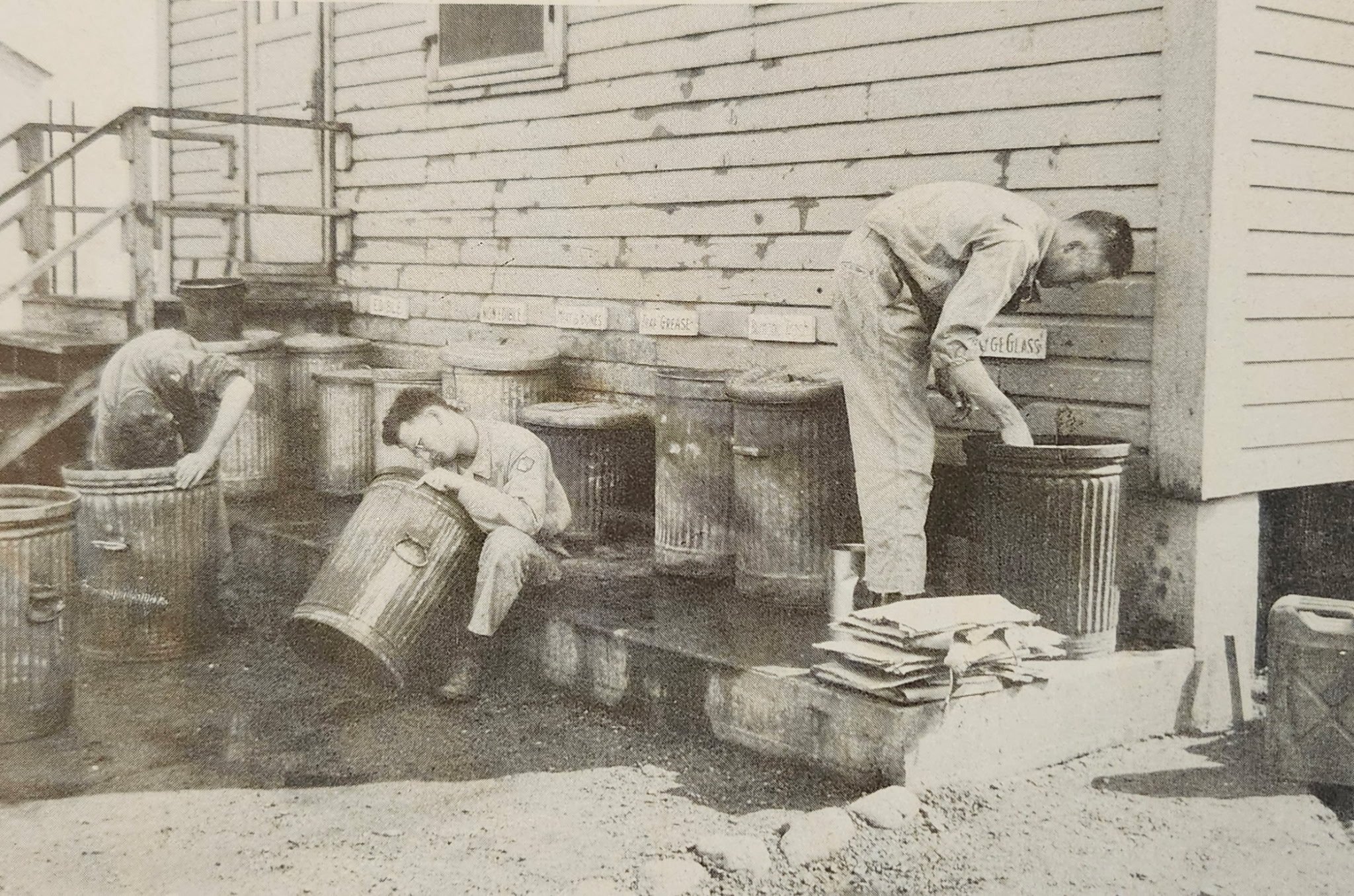
He would also discover that Army life involved plenty of work that had little to do with combat.
Men could be assigned to different Duties, like KP—kitchen police, cleaning details, barracks and area maintenance, warehouse work, and other labor assignments.
The lesson was simple: every soldier had a job, and every soldier was expected to contribute.
Basic Training
After reception and classification, the new soldier would be sent to a training installation for basic training. Basic training was designed to take the civilian and teach him the fundamental skills necessary to function as a soldier.
Training included:
- Close-order drill
- Marching
- Physical conditioning
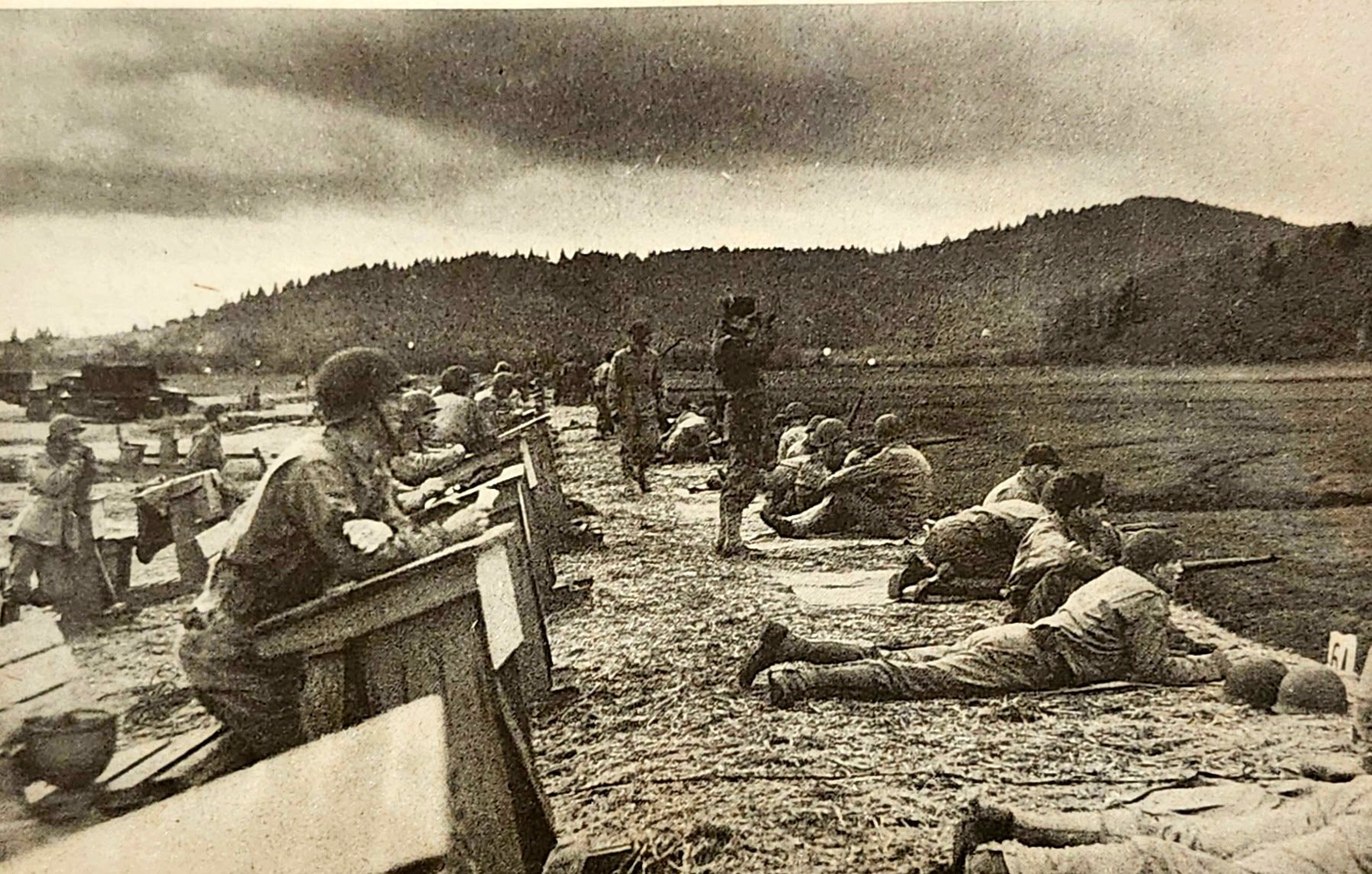
- Rifle marksmanship
- First aid
- Map reading
- Camouflage and concealment
- Field sanitation
- Military orientation
- Guard duty
- Digging foxholes and fighting positions
- Obstacle courses
- Individual fieldcraft
- Basic weapons training
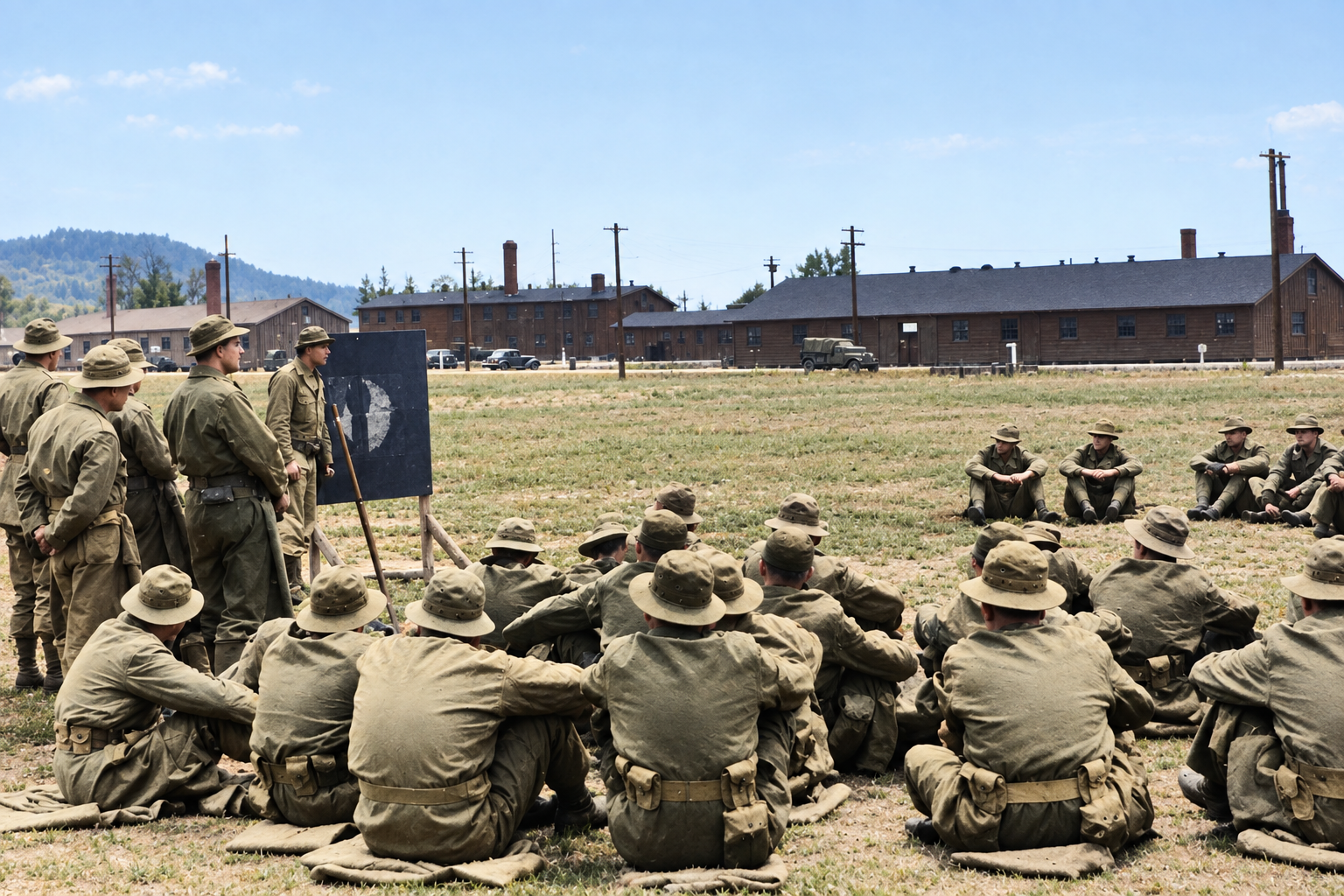
The soldier learned how to wear and maintain his uniform, carry his equipment, handle his rifle, obey commands, move as part of a formation, and function under military discipline.
He also began learning something that would become increasingly important: how to operate as part of a team.
From Basic Training to the Division
Basic training was only the beginning. Once a soldier had learned the fundamentals, he could be assigned to a specialized training program or to a unit where he would continue developing his military skills. For soldiers destined for an infantry division, this next phase was critical. A division was not simply a collection of individual soldiers. It was a complicated organization made up of infantry regiments, artillery, engineers, reconnaissance, medical units, signal personnel, transportation, supply, maintenance, and many other organizations. The men had to learn how to function together. This is where Camp Adair played an important role in the wartime Army.
Camp Adair: Training the Division
Camp Adair was not primarily a basic-training installation in the sense of taking completely new recruits and teaching them the fundamentals of being soldiers.
Instead, Camp Adair was a major divisional training center.
Men arriving at Camp Adair had already gone through the process of becoming soldiers. They had learned basic military discipline, weapons handling, drill, physical conditioning, and fundamental field skills.
At Camp Adair, the emphasis increasingly shifted from the individual soldier to the functioning of the entire military unit.
Men had to learn to work together.
Infantry companies learned to maneuver together. Battalions learned to coordinate their companies. Regiments learned to operate as larger formations. Artillery had to learn how to support infantry. Engineers had to build and clear obstacles. Communications personnel had to keep commanders and units connected. Medical personnel had to establish systems for treating and evacuating wounded men. Supply organizations had to keep ammunition, food, fuel, clothing, and equipment moving.
The individual soldier was becoming part of something much larger.
Learning to Live Together
One of the most important aspects of divisional training was learning to live and work together as a unit.
Thousands of men might arrive from different parts of the country, bringing different backgrounds, occupations, personalities, and levels of education and experience.
At Camp Adair, they lived together in barracks, ate together in mess halls, trained together, marched together, worked together, and endured the same demanding field exercises.
The Army had to turn these individuals into a functioning military organization.
A soldier might be an excellent individual rifleman, but that was not enough. He had to understand where his squad fit into the platoon, where the platoon fit into the company, and where the company fit into the battalion and regiment.
He had to learn to depend upon the men around him—and understand that they depended upon him.
This was one of the fundamental purposes of divisional training.
Camp Adair and the Final Preparation for War
The divisions trained at Camp Adair for extended periods, conducting increasingly complex exercises designed to prepare them for combat.
The training progressed from individual skills to squad and platoon exercises, then to company, battalion, regiment, and finally division-level maneuvers.
The men learned to operate under increasingly realistic battlefield conditions.
They trained in Oregon's forests, fields, roads, hills, and training areas. They learned to move large formations, establish defensive positions, conduct attacks, coordinate artillery and infantry, maintain supply lines, and operate their communications and medical systems.
The goal was to create a division that could function as a single organization.
By the time these men left Camp Adair for overseas service, they were no longer simply civilians who had been drafted into the Army.