
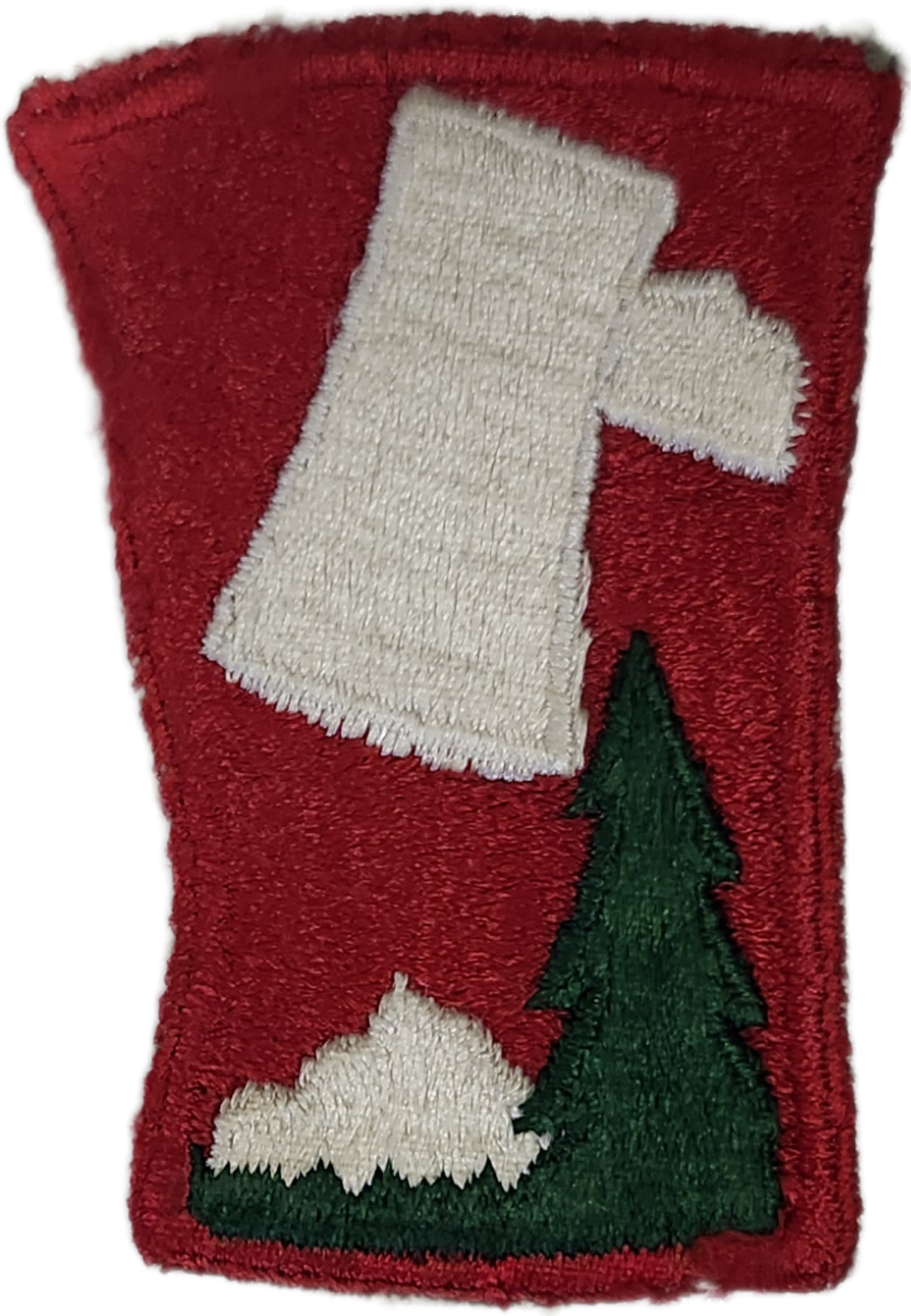
70th Infantry Division “Trailblazers”
From Camp Adair, Oregon, to Germany, 1943–1945
The 70th Infantry Division, nicknamed the “Trailblazers,” was one of four infantry divisions whose wartime history was closely connected with Camp Adair, Oregon. Unlike the 96th and 104th Infantry Divisions, which had been activated at Camp Adair earlier, the 70th was activated there on June 15, 1943. The division's creation was particularly appropriate because June 15 marked the centennial of the beginning of the Oregon Trail migration in 1843. The name “Trailblazers” reflected Oregon's pioneer heritage.
The division's shoulder patch also reflected its Oregon origins. The design incorporated an axe, representing the pioneers who opened trails through the wilderness, along with Mount Hood and a green fir tree. The fir tree represented the 91st Infantry Division, whose officers and noncommissioned officers provided much of the cadre used to form the new 70th Division.
Activation at Camp Adair
The 70th Infantry Division was activated at Camp Adair on June 15, 1943, under IV Corps and the Army Ground Forces. Major General John E. Dahlquist became its first commanding general and remained in command until July 1944.
The division consisted of three infantry regiments:
274th Infantry Regiment
275th Infantry Regiment
276th Infantry Regiment
Supporting them were the division artillery, engineers, medical, reconnaissance, signal, quartermaster, ordnance, military police and other specialized units. Among the major components were the 270th Engineer Combat Battalion, 370th Medical Battalion, 70th Cavalry Reconnaissance Troop, 570th Signal Company, 70th Quartermaster Company and 770th Ordnance Light Maintenance Company. Division artillery included the 725th, 882nd, 883rd and 884th Field Artillery Battalions.
The division's soldiers came from across the United States. Although Oregon and other states of the old Oregon Country contributed men, the division was very much a national Army organization, with personnel representing virtually every part of the country.
Training at Camp Adair
For the next year, Camp Adair became the Trailblazers' home.
Training was intensive. Soldiers learned the fundamentals of infantry warfare while the division's supporting organizations trained to keep thousands of combat troops supplied, medically treated, armed, transported and connected by communications.
The training included weapons firing, infantry tactics, field exercises, communications, engineering, reconnaissance, artillery coordination and large-scale divisional maneuvers. The division also conducted extensive field problems designed to prepare it for the realities of combat overseas.
The 570th Signal Company, for example, was activated at Camp Adair on July 15, 1943, and spent approximately a year training for its eventual combat mission. The division's medical personnel likewise received both technical and field training, including participation in battalion, regimental and divisional exercises.
The Trailblazers were also subjected to rigorous examinations and evaluations. The Camp Adair Sentry reported in December 1943 that the division was undergoing intensive testing in infantry tactics.
This period is particularly important to the history of Camp Adair. The 70th was not simply stationed at Camp Adair—it was created there and developed from a collection of newly assigned soldiers and cadre into a combat division.
From Camp Adair to Fort Leonard Wood
In July 1944, the 70th Infantry Division left Camp Adair and moved by train to Fort Leonard Wood, Missouri. There the division continued its training and prepared for overseas deployment.
The move marked the end of the division's Oregon period, but not the end of its training. At Fort Leonard Wood, the Trailblazers continued large-scale field exercises and technical training while preparing for deployment to the European Theater.
By this point the division had been in existence for more than a year. The men who had assembled at Camp Adair in the summer of 1943 were now preparing to become combat soldiers.
Deployment to Europe
The division began leaving the United States in late 1944.
Its three infantry regiments were sent ahead of the rest of the division. The 274th, 275th and 276th Infantry Regiments landed in France in December 1944 and were immediately committed to operations rather than waiting for the complete division to assemble.
Because the division arrived in Europe while the Germans were launching their major winter offensive in the Ardennes, the three infantry regiments were organized as Task Force Herren, commanded by the division's assistant commander, Brigadier General Thomas W. Herren. They were thrown into the fighting while the remainder of the division was still crossing the Atlantic.
This meant that men of the 70th went from the training grounds of Missouri directly into the crisis created by the German offensive.
The Fighting in France
The Trailblazers operated in northeastern France and the Saar region.
One of the most notable early actions occurred at Wingen, France, where the 2nd Battalion, 274th Infantry, fought from January 5–7, 1945. For its performance, the battalion received a Distinguished Unit Citation.
As additional elements of the division arrived, the 70th became a complete fighting division. Its soldiers participated in operations designed to eliminate German positions and drive toward the Saar River and the German frontier.
The division's combat record included the Ardennes-Alsace, Rhineland and Central Europe campaigns, with the latter two being the official campaign credits commonly associated with the division's World War II record.
The Saar and the Siegfried Line
The Trailblazers' major combat operations centered on the Saar region.
The division fought its way through northeastern France and toward the heavily defended German frontier. Its operations included the reduction of the Bitche salient, the crossing of the Saar River, and attacks against German defensive positions associated with the Siegfried Line.
The 70th eventually pushed toward Saarbrücken, one of the principal objectives in the Saar region. The fighting was difficult, involving fortified positions, villages, forests and heavily defended terrain.
The division's wartime history describes the reduction of the Bitche salient, crossing the Saar and the capture of Saarbrücken as among the major accomplishments of the Trailblazers.
By this stage, the men who had trained on the fields and ranges around Camp Adair were fighting a very different war. Their training in infantry tactics, artillery coordination, communications, engineering and reconnaissance was now being tested under actual combat conditions.
Into Germany
The 70th continued its advance into Germany during the final months of the war.
The division operated in the Saar and southwestern German areas as Allied forces broke through German defenses. Its soldiers fought through villages and fortified positions and continued the advance as German resistance collapsed.
By the time Germany surrendered unconditionally on May 8, 1945, the 70th Infantry Division had established itself in the Frankfurt-am-Main sector.
The war in Europe was over, but the division's military service was not.
Occupation Duty
Following Germany's surrender, the 70th remained in Europe as part of the American occupation forces.
The division was stationed in the Frankfurt area and performed occupation duties while the Army dealt with the enormous problems created by the end of the war—maintaining order, guarding installations and prisoners, securing military property and supporting the occupation of Germany.
For the men of the Trailblazers, this was a very different mission from the combat they had experienced only weeks earlier.
The division remained in the occupation force through the summer of 1945. Brigadier General Thomas W. Herren became commanding general in July 1945, succeeding Major General Allison J. Barnett.
Return to the United States
With the war over and the Army beginning its massive demobilization, the 70th was selected to return home.
The division returned to the United States in October 1945, arriving at the New York Port of Embarkation on approximately October 9–10.
The men then proceeded to Camp Kilmer, New Jersey, a major Army staging and separation center.
On October 11, 1945, less than three weeks after Japan's surrender, the 70th Infantry Division was officially inactivated at Camp Kilmer.
The Trailblazers' wartime journey had come to an end.
The 70th Infantry Division's Journey
Camp Adair, Oregon
June 15, 1943 – July 1944
Activated and trained as a new infantry division.
Fort Leonard Wood, Missouri
July–late 1944
Completed stateside training and prepared for overseas deployment.
France
December 1944
Three infantry regiments arrived ahead of the main division and entered the European fighting as Task Force Herren.
Northeastern France / Saar Region
Winter 1944–1945
Wingen, Bitche area, Saar approaches and other operations.
Saar River / Saarbrücken
1945
Advanced through German defenses and the Siegfried Line.
Germany
Spring 1945
Continued combat operations until the German surrender.
Frankfurt-am-Main Area
May–October 1945
Occupation duty following V-E Day.
Camp Kilmer, New Jersey
October 11, 1945
70th Infantry Division inactivated.
Why the 70th is important to Camp Adair
The 70th Infantry Division is especially significant to Camp Adair because its entire wartime identity began there. The division was activated at Camp Adair, its units were organized there, and its soldiers spent approximately thirteen months training on the Oregon installation before moving east to complete their preparations for overseas combat.
When looking at the surviving foundations at Camp Adair today, it is worth remembering that these weren't simply buildings occupied by an anonymous Army division. The men of the 70th lived, trained, ate, attended services, went to the PX, used the dayrooms, practiced on the ranges and prepared for combat from these very grounds.
The division eventually fought its way across France and into Germany, but its story began in the Willamette Valley.
Camp Adair was where the Trailblazers were born.