
During World War II, the war reached far beyond the battlefields of Europe and the Pacific. Here in the Camp Adair area of Oregon, the Japanese American community was deeply affected by the federal government's wartime removal and incarceration policy.
The Camp Adair Sentry reported in June 1942 account from the period reported that more than 200 Japanese nationals and Japanese Americans from the Camp Adair district had been gathered for evacuation.
Many came from the truck-gardening operations and hop fields north of Camp Adair, where Japanese American families had worked in agriculture. According to the newspaper, the group assembled at the Southern Pacific depot in Salem on a Monday evening. From there, they boarded a special train bound for the newly established Tulelake relocation center, located near the California-Oregon border.
The article noted that the Salem-area group traveled under their own control as they left their homes, but their destination was determined by the federal relocation program. They were among nearly 1,000 people from the Pacific Northwest being sent to Tulelake.
When the United States entered World War II following the attack on Pearl Harbor, Japanese Americans on the West Coast were subjected to increasingly severe restrictions. Executive Order 9066, issued in February 1942, authorized the military exclusion of civilians from designated areas. Japanese Americans were subsequently removed from their homes and sent to government-controlled relocation centers.
For Japanese families living and working around the Camp Adair district, this meant leaving behind farms, businesses, homes, possessions and established communities.
Tulelake
Tulelake, where the Salem-area group was sent, eventually became one of the largest War Relocation Authority centers in the United States. It was later designated a segregation center, particularly for Japanese Americans whom the government classified as disloyal after controversial loyalty questionnaires were administered.
The Camp Adair Sentry article provides a direct connection between this national wartime policy and the local history of the Camp Adair area. More than 200 Japanese nationals and Japanese Americans from the immediate district were among those forced to leave their homes and relocate during the war.
Their story is an often-overlooked part of the history surrounding Camp Adair. While thousands of American soldiers were arriving in Oregon to train for combat overseas, Japanese American families living only a short distance from the future military installation were being removed from their homes and communities.
Camp Adair's history therefore includes not only the soldiers who trained on its fields, but also the civilians whose lives were profoundly changed by the war. The evacuation of Japanese American residents from the Camp Adair area is one of those stories that deserves to be remembered alongside the military history of the wartime community.
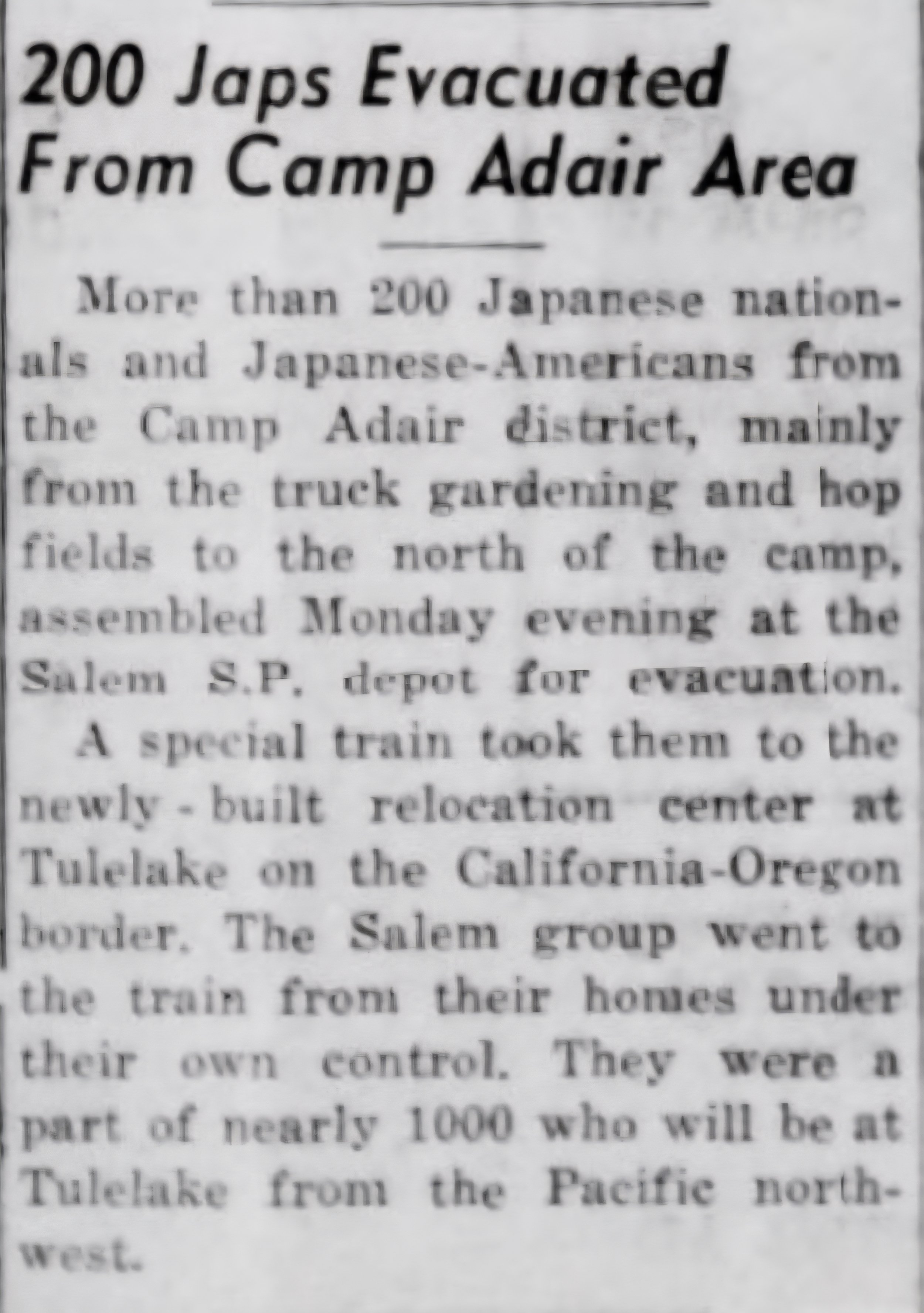
Camp Adair Sentry June 4th, 1942